• APD Avalanche Photodiode Market to Reach USD 179 Million by 2032 Driven by Automotive LiDAR and Optical Communication Growth
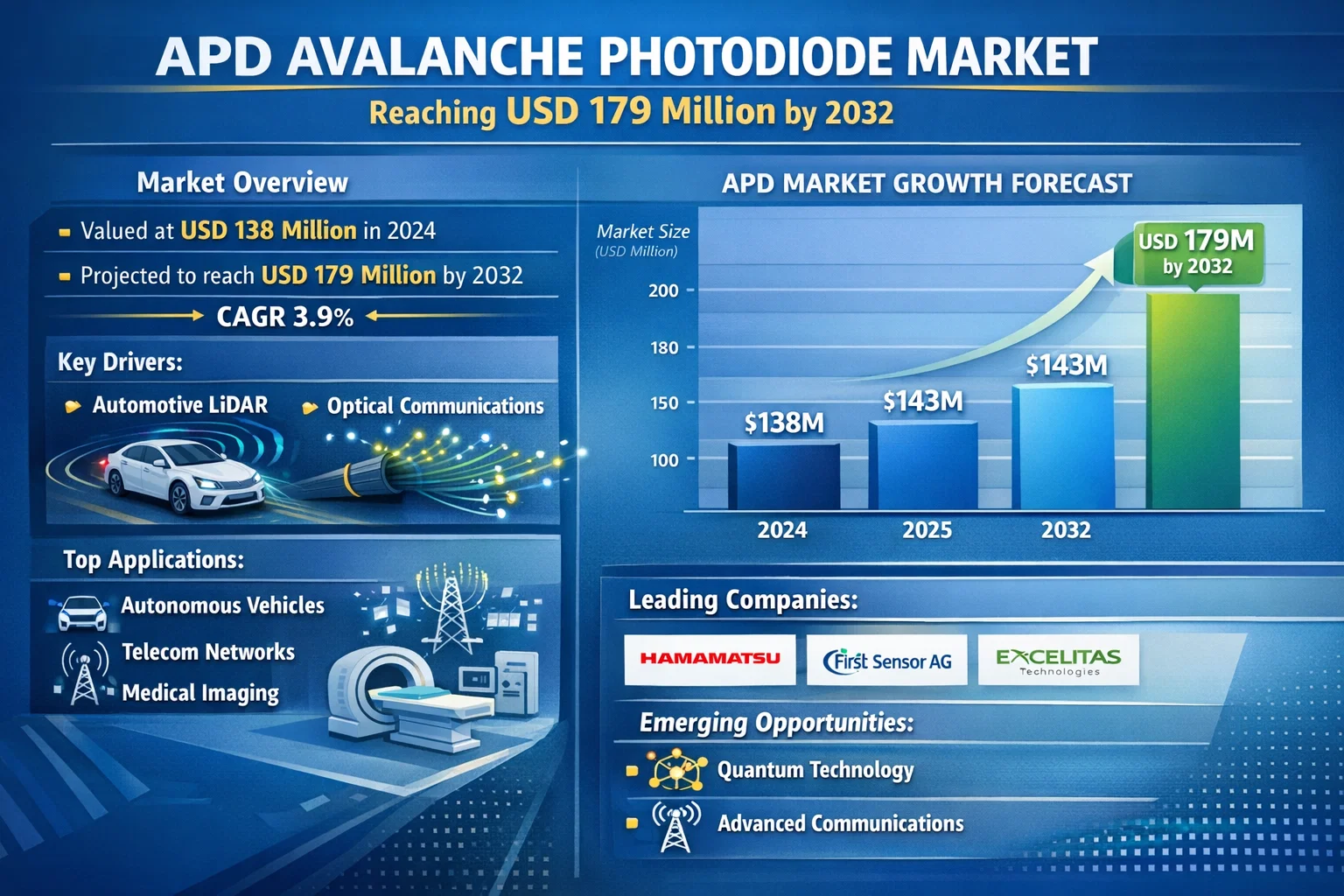
    The global APD Avalanche Photodiode Market was valued at USD 138 million in 2024. The market is projected to grow from USD 143 million in 2025 to USD 179 million by 2032, exhibiting a CAGR of 3.9% during the forecast period, according to a comprehensive new report published by Semiconductor Insight. This growth trajectory highlights the expanding role of APDs as critical components in systems requiring highly sensitive light detection, particularly in fields like autonomous driving, telecommunications, and medical imaging.
    Avalanche Photodiodes (APDs) are semiconductor devices that leverage the avalanche multiplication effect to detect low-intensity light signals with exceptional sensitivity and speed. This unique capability makes them indispensable in applications where traditional photodetectors fall short, such as long-range LiDAR, high-speed optical communication networks, and precision medical diagnostics. Their function in converting light into electrical signals with internal gain allows systems to operate effectively even in challenging low-light conditions, positioning APDs as foundational technology for numerous advanced systems.

    Download FREE Sample Report:
    APD Avalanche Photodiode Market - View in Detailed Research Report
    Automotive and LiDAR Expansion: The Primary Growth Engine
    The report identifies the rapid advancement and adoption of Automotive LiDAR as the paramount driver for the APD market's growth. The proliferation of autonomous vehicles and advanced driver-assistance systems (ADAS) is creating robust demand for high-sensitivity LiDAR systems that rely on APDs for accurate object detection and ranging. This segment's demand is propelled by the rapid integration of LiDAR technology into next-generation vehicles for enhanced autonomy and safety features. High-volume production requirements and stringent quality standards from automotive companies drive innovation and economies of scale in APD manufacturing.
    "The strategic focus on developing next-generation LiDAR systems for automotive safety and smart manufacturing applications continues to propel the demand for high-performance avalanche photodiodes," the report states. Collaborations between APD suppliers and automotive leaders are crucial for developing customized solutions that meet the demanding performance and reliability specifications of the automotive industry. The transition towards higher levels of vehicle autonomy, which requires more sophisticated and reliable sensing capabilities, further intensifies this trend.
    Read Full Report: https://semiconductorinsight.com/report/apd-avalanche-photodiode-market/
    Market Segmentation: Si APD and Automotive Applications Driving Dominance
    The report provides a detailed segmentation analysis, offering a clear view of the market structure and key growth segments:
    Segment Analysis:
    By Type
    Si APD
    InGaAs APD
    Others
    By Application
    Industrial
    Medical
    Mobility
    Others
    By End User
    Automotive OEMs & Tier-1 Suppliers
    Telecommunication Service Providers
    Medical Device Manufacturers
    Industrial Equipment Manufacturers
    Download Sample Report: https://semiconductorinsight.com/download-sample-report/?product_id=127114
    Competitive Landscape: Key Players and Strategic Focus
    The global APD Avalanche Photodiode market is moderately concentrated, with the top three manufacturers collectively holding over 45% of the market share. Hamamatsu Photonics K.K. and First Sensor AG are recognized as global leaders, leveraging their extensive R&D capabilities and established semiconductor manufacturing expertise to dominate the high-performance segment. Their products are critical in applications requiring extreme sensitivity, such as LiDAR for autonomous vehicles and high-speed optical communication systems.
    The report profiles key industry players, including:
    Hamamatsu Photonics K.K. (Japan)
    First Sensor AG (Germany)
    Kyosemi Corporation (Japan)
    Luna Optoelectronics (U.S.)
    Excelitas Technologies Corp. (U.S.)
    Edmund Optics (U.S.)
    GCS (China)
    Accelink Technologies Co., Ltd. (China)
    NORINCO GROUP (China)
    LD-PD Inc. (U.S.)
    Voxtel, Inc. (U.S.)
    Laser Components GmbH (Germany)
    Albis Optoelectronics AG (Switzerland)
    These companies are intensely focused on technological differentiation and material science innovation to enhance performance metrics such as quantum efficiency and noise characteristics. Many are also pursuing geographic expansion into high-growth regions to capture emerging opportunities, particularly in the Asia-Pacific market where manufacturing capabilities are rapidly scaling.
    Emerging Opportunities in Quantum Technology and Advanced Communications
    While automotive LiDAR represents the current growth frontier, the report outlines significant emerging opportunities in quantum technology and next-generation communications. The development of quantum computing and quantum key distribution (QKD) systems requires photodetectors with single-photon sensitivity, a domain where specialized APDs excel. Furthermore, the ongoing global expansion of fiber-optic communication infrastructure, including the push for higher bandwidth 5G and eventual 6G networks, creates sustained demand for high-speed APDs in optical receivers. The integration of APDs into new industrial automation and safety systems further expands their application horizon, underscoring their versatility beyond traditional markets.
    Report Scope and Availability
    The market research report offers a comprehensive analysis of the global and regional APD Avalanche Photodiode markets from 2025-2032. It provides detailed segmentation, market size forecasts, competitive intelligence, technology trends, and an evaluation of key market dynamics, including the impact of material innovations like InGaAs for longer wavelength detection and the competitive pressures shaping the industry landscape.
    For a detailed analysis of market drivers, restraints, opportunities, and the competitive strategies of key players, access the complete report.
    Get Full Report Here: APD Avalanche Photodiode Market, Global Business Strategies 2025-2032 - View in Detailed Research Report
    Download Sample Report: https://semiconductorinsight.com/download-sample-report/?product_id=127114
    About Semiconductor Insight
    Semiconductor Insight is a leading provider of market intelligence and strategic consulting for the global semiconductor and high-technology industries. Our in-depth reports and analysis offer actionable insights to help businesses navigate complex market dynamics, identify growth opportunities, and make informed decisions. We are committed to delivering high-quality, data-driven research to our clients worldwide.
    Website: https://semiconductorinsight.com/
    International: +91 8087 99 2013
    LinkedIn: Follow Us
    #APDMarket
    #AvalanchePhotodiode
    #SemiconductorIndustry
    #LiDARTechnology
    #AutonomousVehicles
    #OpticalCommunication
    #Photonics
    #QuantumTechnology
    #ADAS
    #Optoelectronics
    #SemiconductorMarket
    #TechInnovation
    APD Avalanche Photodiode Market to Reach USD 179 Million by 2032 Driven by Automotive LiDAR and Optical Communication Growth The global APD Avalanche Photodiode Market was valued at USD 138 million in 2024. The market is projected to grow from USD 143 million in 2025 to USD 179 million by 2032, exhibiting a CAGR of 3.9% during the forecast period, according to a comprehensive new report published by Semiconductor Insight. This growth trajectory highlights the expanding role of APDs as critical components in systems requiring highly sensitive light detection, particularly in fields like autonomous driving, telecommunications, and medical imaging. Avalanche Photodiodes (APDs) are semiconductor devices that leverage the avalanche multiplication effect to detect low-intensity light signals with exceptional sensitivity and speed. This unique capability makes them indispensable in applications where traditional photodetectors fall short, such as long-range LiDAR, high-speed optical communication networks, and precision medical diagnostics. Their function in converting light into electrical signals with internal gain allows systems to operate effectively even in challenging low-light conditions, positioning APDs as foundational technology for numerous advanced systems. Download FREE Sample Report: APD Avalanche Photodiode Market - View in Detailed Research Report Automotive and LiDAR Expansion: The Primary Growth Engine The report identifies the rapid advancement and adoption of Automotive LiDAR as the paramount driver for the APD market's growth. The proliferation of autonomous vehicles and advanced driver-assistance systems (ADAS) is creating robust demand for high-sensitivity LiDAR systems that rely on APDs for accurate object detection and ranging. This segment's demand is propelled by the rapid integration of LiDAR technology into next-generation vehicles for enhanced autonomy and safety features. High-volume production requirements and stringent quality standards from automotive companies drive innovation and economies of scale in APD manufacturing. "The strategic focus on developing next-generation LiDAR systems for automotive safety and smart manufacturing applications continues to propel the demand for high-performance avalanche photodiodes," the report states. Collaborations between APD suppliers and automotive leaders are crucial for developing customized solutions that meet the demanding performance and reliability specifications of the automotive industry. The transition towards higher levels of vehicle autonomy, which requires more sophisticated and reliable sensing capabilities, further intensifies this trend. Read Full Report: https://semiconductorinsight.com/report/apd-avalanche-photodiode-market/ Market Segmentation: Si APD and Automotive Applications Driving Dominance The report provides a detailed segmentation analysis, offering a clear view of the market structure and key growth segments: Segment Analysis: By Type Si APD InGaAs APD Others By Application Industrial Medical Mobility Others By End User Automotive OEMs & Tier-1 Suppliers Telecommunication Service Providers Medical Device Manufacturers Industrial Equipment Manufacturers Download Sample Report: https://semiconductorinsight.com/download-sample-report/?product_id=127114 Competitive Landscape: Key Players and Strategic Focus The global APD Avalanche Photodiode market is moderately concentrated, with the top three manufacturers collectively holding over 45% of the market share. Hamamatsu Photonics K.K. and First Sensor AG are recognized as global leaders, leveraging their extensive R&D capabilities and established semiconductor manufacturing expertise to dominate the high-performance segment. Their products are critical in applications requiring extreme sensitivity, such as LiDAR for autonomous vehicles and high-speed optical communication systems. The report profiles key industry players, including: Hamamatsu Photonics K.K. (Japan) First Sensor AG (Germany) Kyosemi Corporation (Japan) Luna Optoelectronics (U.S.) Excelitas Technologies Corp. (U.S.) Edmund Optics (U.S.) GCS (China) Accelink Technologies Co., Ltd. (China) NORINCO GROUP (China) LD-PD Inc. (U.S.) Voxtel, Inc. (U.S.) Laser Components GmbH (Germany) Albis Optoelectronics AG (Switzerland) These companies are intensely focused on technological differentiation and material science innovation to enhance performance metrics such as quantum efficiency and noise characteristics. Many are also pursuing geographic expansion into high-growth regions to capture emerging opportunities, particularly in the Asia-Pacific market where manufacturing capabilities are rapidly scaling. Emerging Opportunities in Quantum Technology and Advanced Communications While automotive LiDAR represents the current growth frontier, the report outlines significant emerging opportunities in quantum technology and next-generation communications. The development of quantum computing and quantum key distribution (QKD) systems requires photodetectors with single-photon sensitivity, a domain where specialized APDs excel. Furthermore, the ongoing global expansion of fiber-optic communication infrastructure, including the push for higher bandwidth 5G and eventual 6G networks, creates sustained demand for high-speed APDs in optical receivers. The integration of APDs into new industrial automation and safety systems further expands their application horizon, underscoring their versatility beyond traditional markets. Report Scope and Availability The market research report offers a comprehensive analysis of the global and regional APD Avalanche Photodiode markets from 2025-2032. It provides detailed segmentation, market size forecasts, competitive intelligence, technology trends, and an evaluation of key market dynamics, including the impact of material innovations like InGaAs for longer wavelength detection and the competitive pressures shaping the industry landscape. For a detailed analysis of market drivers, restraints, opportunities, and the competitive strategies of key players, access the complete report. Get Full Report Here: APD Avalanche Photodiode Market, Global Business Strategies 2025-2032 - View in Detailed Research Report Download Sample Report: https://semiconductorinsight.com/download-sample-report/?product_id=127114 About Semiconductor Insight Semiconductor Insight is a leading provider of market intelligence and strategic consulting for the global semiconductor and high-technology industries. Our in-depth reports and analysis offer actionable insights to help businesses navigate complex market dynamics, identify growth opportunities, and make informed decisions. We are committed to delivering high-quality, data-driven research to our clients worldwide. 🌐 Website: https://semiconductorinsight.com/ 📞 International: +91 8087 99 2013 🔗 LinkedIn: Follow Us #APDMarket #AvalanchePhotodiode #SemiconductorIndustry #LiDARTechnology #AutonomousVehicles #OpticalCommunication #Photonics #QuantumTechnology #ADAS #Optoelectronics #SemiconductorMarket #TechInnovation
    0 Yorumlar 0 hisse senetleri 510 Views 0 önizleme
  • Lead Frame Market to Reach USD 4.98 Billion by 2032 | Growing Demand from Semiconductor Packaging & Electronics Industry
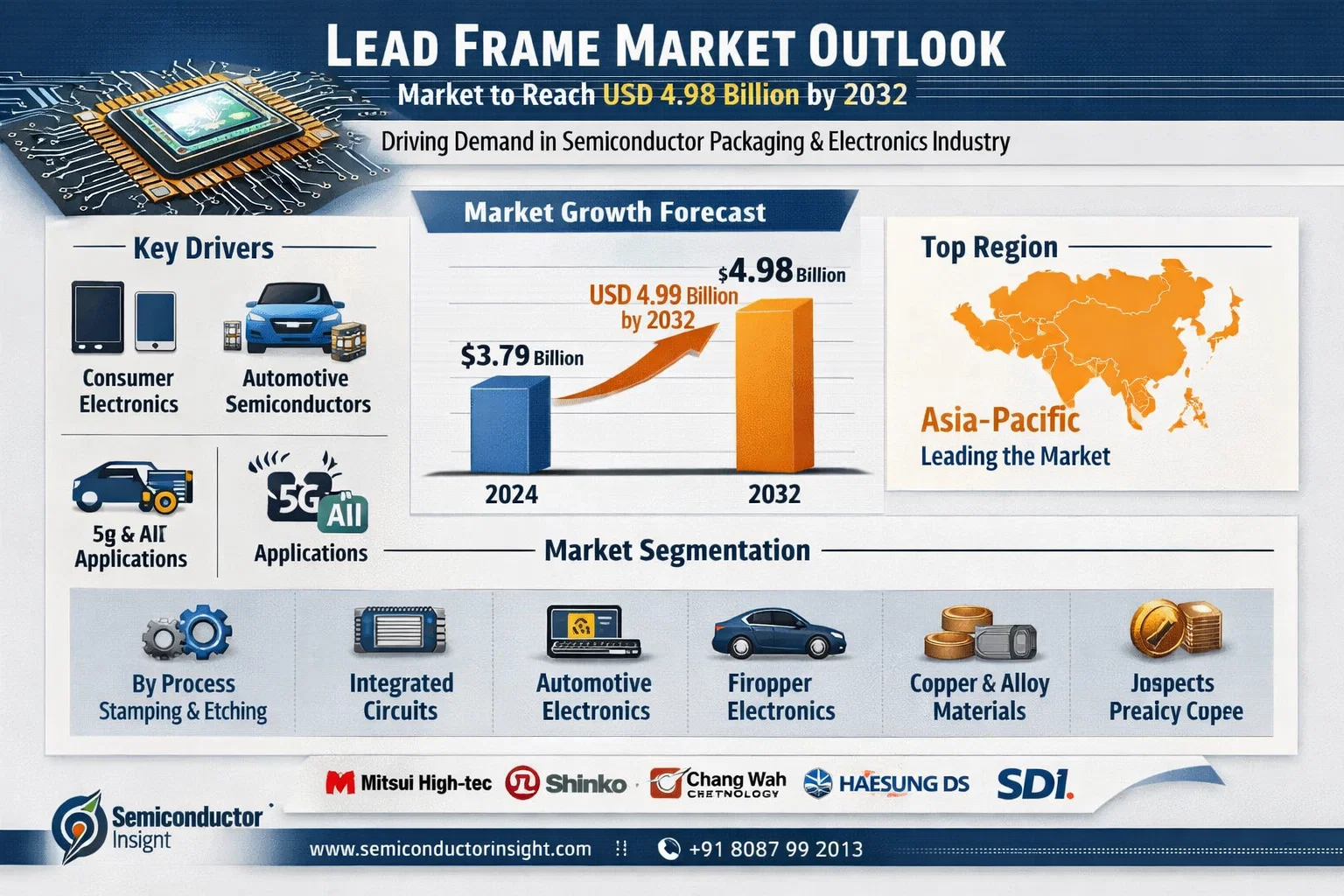
    The global Lead Frame Market, valued at a robust USD 3.79 billion in 2024, is on a steady growth trajectory, projected to reach USD 4.98 billion by 2032. This expansion, representing a compound annual growth rate (CAGR) of 4.1%, is detailed in a comprehensive new report published by Semiconductor Insight. The study underscores the indispensable role of these critical components in semiconductor packaging, highlighting their function as the foundational metal structures that provide mechanical support, electrical connectivity, and heat dissipation for integrated circuits and discrete devices.
    Lead frames, the metallic skeletons upon which semiconductor dies are mounted and connected, are paramount to the performance and longevity of virtually all electronic devices. Their design directly influences factors such as signal integrity, thermal management, and overall package form factor. As semiconductor technology continues its relentless march towards miniaturization and higher performance, the demand for advanced lead frames with finer pitches and enhanced materials is intensifying.
    Download FREE Sample Report:
    Lead Frame Market - View in Detailed Research Report
    Proliferation of Electronics and Automotive Semiconductor Demand: Primary Growth Engines
    The report identifies the ubiquitous expansion of the global electronics sector as the paramount driver for lead frame demand. The correlation is direct and substantial, with the integrated circuit application segment constituting the largest downstream application for lead frames. The consumer electronics segment, in particular, creates a massive and consistent demand for lead frames, driven by relentless innovation and high-volume production cycles for smartphones, laptops, and wearables.
    "The Asia-Pacific region is the undisputed epicenter of the global lead frame market, accounting for a dominant share of both production and consumption," the report states. This concentration is fueled by the region's unparalleled electronics manufacturing ecosystem, which encompasses everything from semiconductor fabrication and assembly to final product assembly. With extensive supply chains for key raw materials like copper alloy and a highly skilled workforce, Asia-Pacific producers are exceptionally well-positioned to meet the evolving demands of the global semiconductor industry, particularly as packaging technologies advance to support devices for 5G, AI, and automotive applications.
    Read Full Report: https://semiconductorinsight.com/report/lead-frame-market/
    Market Segmentation: Stamping Process and Integrated Circuit Applications Dominate
    The report provides a detailed segmentation analysis, offering a clear view of the market structure and key growth segments:
    Segment Analysis:
    By Process
    Stamping Process Leadframe
    Etching Process Leadframe
    By Application
    Integrated Circuit
    Discrete Device
    Others
    By End User
    Consumer Electronics
    Automotive Industry
    Industrial & Telecommunication
    By Material
    Copper Alloy
    Alloy 42
    Other Specialty Alloys
    Download Sample Report: https://semiconductorinsight.com/download-sample-report/?product_id=127113
    Competitive Landscape: Key Players and Strategic Focus
    The report profiles key industry players, including:
    Mitsui High-tec (Japan)
    Shinko Electric Industries Co., Ltd. (Japan)
    Chang Wah Technology Co., Ltd. (Taiwan)
    Advanced Assembly Materials International Ltd. (AAMI) (Hong Kong)
    HAESUNG DS Co., Ltd. (South Korea)
    SDI (South Korea)
    Fusheng Electronics (Taiwan)
    Enomoto Co., Ltd. (Japan)
    Kangqiang Electronics (China)
    POSSEHL (Germany)
    JIH LIN TECHNOLOGY CO., LTD. (Taiwan)
    Jentech Precision Industrial Co., Ltd. (Taiwan)
    Hualong (China)
    Dynacraft Industries (India)
    QPL Limited (Hong Kong)
    These companies are focusing on technological advancements, such as developing lead frames for advanced packaging like QFN and QFP, and expanding production capacity in high-growth regions like Southeast Asia to capitalize on the shifting global supply chain and increasing demand.
    Emerging Opportunities in Advanced Packaging and Automotive Electrification
    Beyond traditional consumer electronics drivers, the report outlines significant emerging opportunities. The rapid expansion of electric vehicle (EV) production and the integration of advanced driver-assistance systems (ADAS) present substantial new growth avenues, requiring high-reliability lead frames for power semiconductors and sensors. The transition to more complex semiconductor packages for high-performance computing and 5G infrastructure, which demand lead frames with superior electrical and thermal characteristics, represents another key trend. The ongoing industry-wide push for supply chain resilience and localized manufacturing is also prompting strategic investments and partnerships within the lead frame sector, creating new competitive dynamics.
    Report Scope and Availability
    The market research report offers a comprehensive analysis of the global and regional Lead Frame markets from 2025–2032. It provides detailed segmentation, market size forecasts, competitive intelligence, technology trends, and an evaluation of key market dynamics.
    For a detailed analysis of market drivers, restraints, opportunities, and the competitive strategies of key players, access the complete report.
    Read Full Report: https://semiconductorinsight.com/report/lead-frame-market/
    Download Sample Report: https://semiconductorinsight.com/download-sample-report/?product_id=127113
    Get Full Report Here:
    Lead Frame Market, Global Business Strategies 2025-2032 - View in Detailed Research Report
    About Semiconductor Insight
    Semiconductor Insight is a leading provider of market intelligence and strategic consulting for the global semiconductor and high-technology industries. Our in-depth reports and analysis offer actionable insights to help businesses navigate complex market dynamics, identify growth opportunities, and make informed decisions. We are committed to delivering high-quality, data-driven research to our clients worldwide.
    Website: https://semiconductorinsight.com/
    International: +91 8087 99 2013
    LinkedIn: Follow Us
    #LeadFrameMarket
    #SemiconductorPackaging
    #SemiconductorIndustry
    #ElectronicsManufacturing
    #IntegratedCircuits
    #AutomotiveSemiconductors
    #EVTechnology
    #5GTechnology
    #AdvancedPackaging
    #MarketGrowth
    #ElectronicsIndustry
    #AIandSemiconductors
    #ChipPackaging
    #IndustrialElectronics
    #SemiconductorInsight
    Lead Frame Market to Reach USD 4.98 Billion by 2032 | Growing Demand from Semiconductor Packaging & Electronics Industry The global Lead Frame Market, valued at a robust USD 3.79 billion in 2024, is on a steady growth trajectory, projected to reach USD 4.98 billion by 2032. This expansion, representing a compound annual growth rate (CAGR) of 4.1%, is detailed in a comprehensive new report published by Semiconductor Insight. The study underscores the indispensable role of these critical components in semiconductor packaging, highlighting their function as the foundational metal structures that provide mechanical support, electrical connectivity, and heat dissipation for integrated circuits and discrete devices. Lead frames, the metallic skeletons upon which semiconductor dies are mounted and connected, are paramount to the performance and longevity of virtually all electronic devices. Their design directly influences factors such as signal integrity, thermal management, and overall package form factor. As semiconductor technology continues its relentless march towards miniaturization and higher performance, the demand for advanced lead frames with finer pitches and enhanced materials is intensifying. Download FREE Sample Report: Lead Frame Market - View in Detailed Research Report Proliferation of Electronics and Automotive Semiconductor Demand: Primary Growth Engines The report identifies the ubiquitous expansion of the global electronics sector as the paramount driver for lead frame demand. The correlation is direct and substantial, with the integrated circuit application segment constituting the largest downstream application for lead frames. The consumer electronics segment, in particular, creates a massive and consistent demand for lead frames, driven by relentless innovation and high-volume production cycles for smartphones, laptops, and wearables. "The Asia-Pacific region is the undisputed epicenter of the global lead frame market, accounting for a dominant share of both production and consumption," the report states. This concentration is fueled by the region's unparalleled electronics manufacturing ecosystem, which encompasses everything from semiconductor fabrication and assembly to final product assembly. With extensive supply chains for key raw materials like copper alloy and a highly skilled workforce, Asia-Pacific producers are exceptionally well-positioned to meet the evolving demands of the global semiconductor industry, particularly as packaging technologies advance to support devices for 5G, AI, and automotive applications. Read Full Report: https://semiconductorinsight.com/report/lead-frame-market/ Market Segmentation: Stamping Process and Integrated Circuit Applications Dominate The report provides a detailed segmentation analysis, offering a clear view of the market structure and key growth segments: Segment Analysis: By Process Stamping Process Leadframe Etching Process Leadframe By Application Integrated Circuit Discrete Device Others By End User Consumer Electronics Automotive Industry Industrial & Telecommunication By Material Copper Alloy Alloy 42 Other Specialty Alloys Download Sample Report: https://semiconductorinsight.com/download-sample-report/?product_id=127113 Competitive Landscape: Key Players and Strategic Focus The report profiles key industry players, including: Mitsui High-tec (Japan) Shinko Electric Industries Co., Ltd. (Japan) Chang Wah Technology Co., Ltd. (Taiwan) Advanced Assembly Materials International Ltd. (AAMI) (Hong Kong) HAESUNG DS Co., Ltd. (South Korea) SDI (South Korea) Fusheng Electronics (Taiwan) Enomoto Co., Ltd. (Japan) Kangqiang Electronics (China) POSSEHL (Germany) JIH LIN TECHNOLOGY CO., LTD. (Taiwan) Jentech Precision Industrial Co., Ltd. (Taiwan) Hualong (China) Dynacraft Industries (India) QPL Limited (Hong Kong) These companies are focusing on technological advancements, such as developing lead frames for advanced packaging like QFN and QFP, and expanding production capacity in high-growth regions like Southeast Asia to capitalize on the shifting global supply chain and increasing demand. Emerging Opportunities in Advanced Packaging and Automotive Electrification Beyond traditional consumer electronics drivers, the report outlines significant emerging opportunities. The rapid expansion of electric vehicle (EV) production and the integration of advanced driver-assistance systems (ADAS) present substantial new growth avenues, requiring high-reliability lead frames for power semiconductors and sensors. The transition to more complex semiconductor packages for high-performance computing and 5G infrastructure, which demand lead frames with superior electrical and thermal characteristics, represents another key trend. The ongoing industry-wide push for supply chain resilience and localized manufacturing is also prompting strategic investments and partnerships within the lead frame sector, creating new competitive dynamics. Report Scope and Availability The market research report offers a comprehensive analysis of the global and regional Lead Frame markets from 2025–2032. It provides detailed segmentation, market size forecasts, competitive intelligence, technology trends, and an evaluation of key market dynamics. For a detailed analysis of market drivers, restraints, opportunities, and the competitive strategies of key players, access the complete report. Read Full Report: https://semiconductorinsight.com/report/lead-frame-market/ Download Sample Report: https://semiconductorinsight.com/download-sample-report/?product_id=127113 Get Full Report Here: Lead Frame Market, Global Business Strategies 2025-2032 - View in Detailed Research Report About Semiconductor Insight Semiconductor Insight is a leading provider of market intelligence and strategic consulting for the global semiconductor and high-technology industries. Our in-depth reports and analysis offer actionable insights to help businesses navigate complex market dynamics, identify growth opportunities, and make informed decisions. We are committed to delivering high-quality, data-driven research to our clients worldwide. 🌐 Website: https://semiconductorinsight.com/ 📞 International: +91 8087 99 2013 🔗 LinkedIn: Follow Us #LeadFrameMarket #SemiconductorPackaging #SemiconductorIndustry #ElectronicsManufacturing #IntegratedCircuits #AutomotiveSemiconductors #EVTechnology #5GTechnology #AdvancedPackaging #MarketGrowth #ElectronicsIndustry #AIandSemiconductors #ChipPackaging #IndustrialElectronics #SemiconductorInsight
    0 Yorumlar 0 hisse senetleri 533 Views 0 önizleme
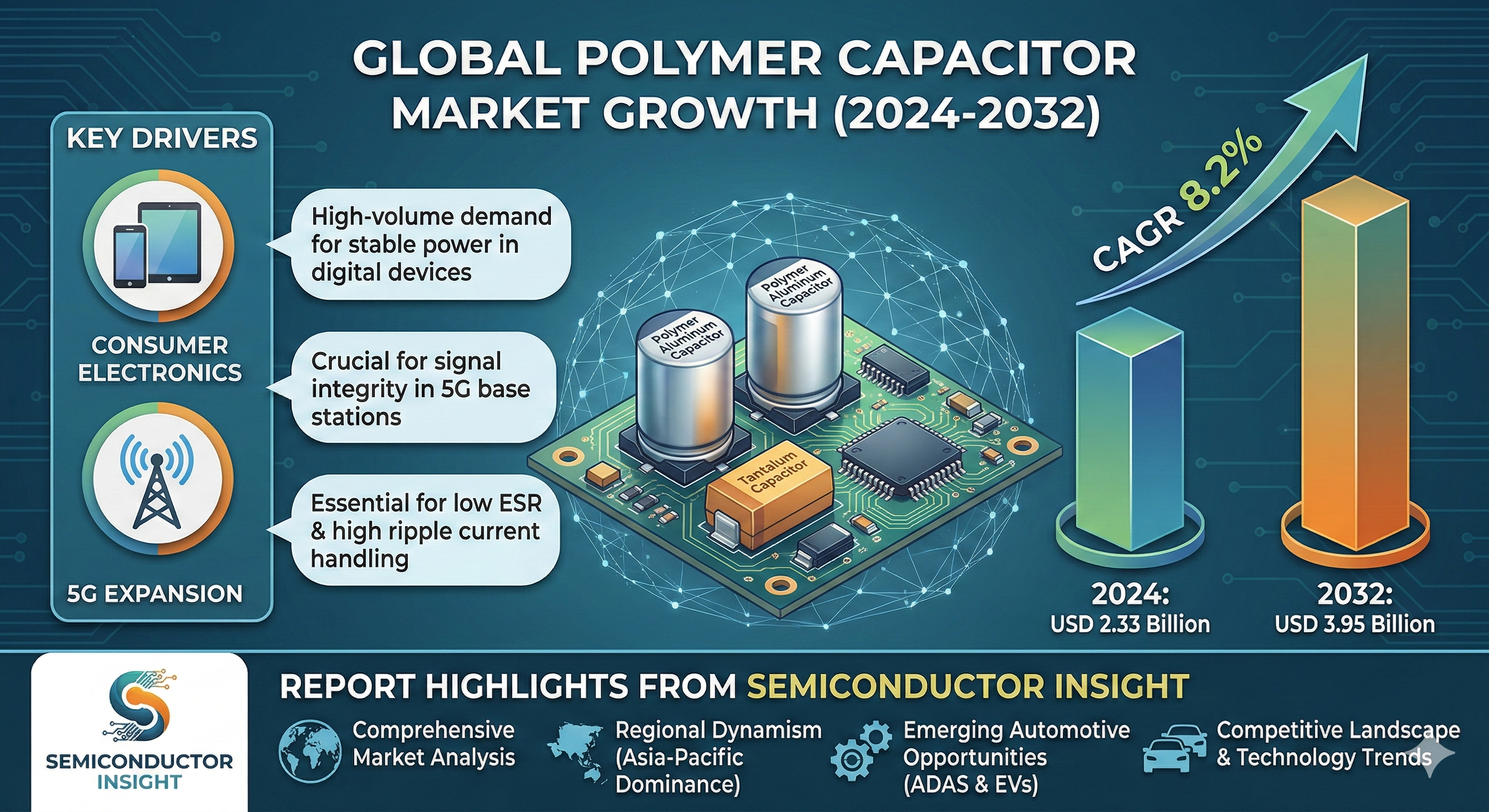
  • Global Polymer Capacitor Market Set to Reach USD 3.95 Billion by 2032, Driven by Consumer Electronics and 5G Expansion
    The global Polymer Capacitor Market, valued at USD 2.33 billion in 2024, is on a trajectory of significant expansion, projected to reach USD 3.95 billion by 2032. This growth, representing a compound annual growth rate (CAGR) of 8.2%, is detailed in a comprehensive new report published by Semiconductor Insight. The study highlights the critical role of these advanced electronic components in ensuring stable power delivery and signal integrity across a vast spectrum of modern technologies, particularly in the high-volume consumer electronics sector.
    Polymer capacitors, essential for smoothing voltage and filtering noise in high-frequency circuits, are becoming indispensable for modern electronic design. Their superior electrical characteristics, including low equivalent series resistance (ESR) and high ripple current handling, make them a cornerstone of digital devices, from the smartphone in your pocket to the sophisticated servers powering the cloud. These components are increasingly favored over traditional alternatives because they offer enhanced performance and reliability in increasingly compact and power-hungry devices. Their robustness and long operational life are key factors driving their adoption in applications where failure is not an option.
    Consumer Electronics Proliferation: The Primary Growth Engine
    The report identifies the relentless global demand for consumer electronics as the paramount driver for polymer capacitor growth. With this segment accounting for the largest share of global demand, the correlation between consumer device shipments and capacitor consumption is direct and substantial. The global consumer electronics market itself continues to see billions of units shipped annually, fueling consistent, high-volume demand for these critical components.
    "The massive concentration of electronics manufacturing and original equipment manufacturers (OEMs) in the Asia-Pacific region, which is the dominant consumer and producer, is a key factor in the market's dynamism," the report states. With the proliferation of features like 5G connectivity, high-resolution displays, and advanced mobile computing, the need for stable, efficient power management solutions is set to intensify, especially as processing speeds increase and device form factors shrink.
    Download FREE Sample Report:
    Polymer Capacitor Market - View in Detailed Research Report
    Market Segmentation: Polymer Aluminum Capacitors and Consumer Applications Dominate
    The report provides a detailed segmentation analysis, offering a clear view of the market structure and key growth segments:
    Segment Analysis:
    By Type
    Polymer Tantalum Electrolytic Capacitor
    Polymer Aluminum Electrolytic Capacitor
    Others (Hybrid and Niobium)
    By Application
    Consumer Electronics
    Automotive
    Industrial
    Others
    Telecommunications Infrastructure
    Power Supplies
    Computing Hardware
    Others
    By End User
    Original Equipment Manufacturers (OEMs)
    Electronic Manufacturing Services (EMS)
    Aftermarket/Component Distributors
    Get Full Report Here:
    Polymer Capacitor Market, Global Business Strategies 2025-2032 - View in Detailed Research Report
    Competitive Landscape: Key Players and Strategic Focus
    The report profiles key industry players, including:
    Murata Manufacturing Co., Ltd.
    Nichicon Corporation
    Panasonic Corporation
    KEMET (Yageo Corporation)
    Nippon Chemi-Con (NCC)
    Rubycon Corporation
    AVX Corporation (Kyocera Group)
    Vishay Intertechnology, Inc.
    TDK Corporation
    Apaq Technology Co., Ltd.
    Lelon Electronics Corp.
    Jianghai Capacitor
    Aihua Group
    Illinois Capacitor, Inc.
    Shenzhen Maxking Electronics Co., Ltd.
    These companies are focusing on technological advancements, such as developing capacitors with higher capacitance density and improved thermal stability, and geographic expansion into high-growth regions to capitalize on emerging opportunities.
    Emerging Opportunities in Automotive and 5G Infrastructure
    Beyond traditional drivers, the report outlines significant emerging opportunities. The rapid electrification of the automotive industry, particularly the expansion of Advanced Driver Assistance Systems (ADAS) and electric vehicle powertrains, presents new growth avenues, requiring robust and reliable capacitors for safety-critical and high-power applications. Furthermore, the global rollout of 5G networks is a major trend. Polymer capacitors are essential in 5G base stations and network equipment, creating sustained demand from this high-growth sector.
    Report Scope and Availability
    The market research report offers a comprehensive analysis of the global and regional Polymer Capacitor markets from 2025–2032. It provides detailed segmentation, market size forecasts, competitive intelligence, technology trends, and an evaluation of key market dynamics.
    For a detailed analysis of market drivers, restraints, opportunities, and the competitive strategies of key players, access the complete report.
    Read Full Report: https://semiconductorinsight.com/download-sample-report/?product_id=122478
    Download Sample Report: https://semiconductorinsight.com/


    Other Related Reports:
    Light Sources for Lithography Market
    Quantum Chip Market
    Global Radio Frequency and Microwave Filter Market
    India Optical Component Market
    Global Multi-mode Receiver (MMR) Market
    Silicon Quantum Dot Market
    Optical Detection Biosensors Market
    Global Desktop USB Port Chargers Market
    NDIR (Non-Dispersive Infrared) Gas Sensors Market
    Electric Vehicle Hall Current Sensors Market
    About Semiconductor Insight
    Semiconductor Insight is a leading provider of market intelligence and strategic consulting for the global semiconductor and high-technology industries. Our in-depth reports and analysis offer actionable insights to help businesses navigate complex market dynamics, identify growth opportunities, and make informed decisions. We are committed to delivering high-quality, data-driven research to our clients worldwide.
    Website: https://semiconductorinsight.com/
    International: +91 8087 99 2013
    LinkedIn: Follow Us
    #PolymerCapacitors #SemiconductorIndustry #ElectronicsManufacturing #5GTechnology #EVInnovation #TechTrends2032 #ConsumerElectronics #PassiveComponents #MarketResearch #EnergyEfficiency #TechGrowth


    Global Polymer Capacitor Market Set to Reach USD 3.95 Billion by 2032, Driven by Consumer Electronics and 5G Expansion The global Polymer Capacitor Market, valued at USD 2.33 billion in 2024, is on a trajectory of significant expansion, projected to reach USD 3.95 billion by 2032. This growth, representing a compound annual growth rate (CAGR) of 8.2%, is detailed in a comprehensive new report published by Semiconductor Insight. The study highlights the critical role of these advanced electronic components in ensuring stable power delivery and signal integrity across a vast spectrum of modern technologies, particularly in the high-volume consumer electronics sector. Polymer capacitors, essential for smoothing voltage and filtering noise in high-frequency circuits, are becoming indispensable for modern electronic design. Their superior electrical characteristics, including low equivalent series resistance (ESR) and high ripple current handling, make them a cornerstone of digital devices, from the smartphone in your pocket to the sophisticated servers powering the cloud. These components are increasingly favored over traditional alternatives because they offer enhanced performance and reliability in increasingly compact and power-hungry devices. Their robustness and long operational life are key factors driving their adoption in applications where failure is not an option. Consumer Electronics Proliferation: The Primary Growth Engine The report identifies the relentless global demand for consumer electronics as the paramount driver for polymer capacitor growth. With this segment accounting for the largest share of global demand, the correlation between consumer device shipments and capacitor consumption is direct and substantial. The global consumer electronics market itself continues to see billions of units shipped annually, fueling consistent, high-volume demand for these critical components. "The massive concentration of electronics manufacturing and original equipment manufacturers (OEMs) in the Asia-Pacific region, which is the dominant consumer and producer, is a key factor in the market's dynamism," the report states. With the proliferation of features like 5G connectivity, high-resolution displays, and advanced mobile computing, the need for stable, efficient power management solutions is set to intensify, especially as processing speeds increase and device form factors shrink. Download FREE Sample Report: Polymer Capacitor Market - View in Detailed Research Report Market Segmentation: Polymer Aluminum Capacitors and Consumer Applications Dominate The report provides a detailed segmentation analysis, offering a clear view of the market structure and key growth segments: Segment Analysis: By Type Polymer Tantalum Electrolytic Capacitor Polymer Aluminum Electrolytic Capacitor Others (Hybrid and Niobium) By Application Consumer Electronics Automotive Industrial Others Telecommunications Infrastructure Power Supplies Computing Hardware Others By End User Original Equipment Manufacturers (OEMs) Electronic Manufacturing Services (EMS) Aftermarket/Component Distributors Get Full Report Here: Polymer Capacitor Market, Global Business Strategies 2025-2032 - View in Detailed Research Report Competitive Landscape: Key Players and Strategic Focus The report profiles key industry players, including: Murata Manufacturing Co., Ltd. Nichicon Corporation Panasonic Corporation KEMET (Yageo Corporation) Nippon Chemi-Con (NCC) Rubycon Corporation AVX Corporation (Kyocera Group) Vishay Intertechnology, Inc. TDK Corporation Apaq Technology Co., Ltd. Lelon Electronics Corp. Jianghai Capacitor Aihua Group Illinois Capacitor, Inc. Shenzhen Maxking Electronics Co., Ltd. These companies are focusing on technological advancements, such as developing capacitors with higher capacitance density and improved thermal stability, and geographic expansion into high-growth regions to capitalize on emerging opportunities. Emerging Opportunities in Automotive and 5G Infrastructure Beyond traditional drivers, the report outlines significant emerging opportunities. The rapid electrification of the automotive industry, particularly the expansion of Advanced Driver Assistance Systems (ADAS) and electric vehicle powertrains, presents new growth avenues, requiring robust and reliable capacitors for safety-critical and high-power applications. Furthermore, the global rollout of 5G networks is a major trend. Polymer capacitors are essential in 5G base stations and network equipment, creating sustained demand from this high-growth sector. Report Scope and Availability The market research report offers a comprehensive analysis of the global and regional Polymer Capacitor markets from 2025–2032. It provides detailed segmentation, market size forecasts, competitive intelligence, technology trends, and an evaluation of key market dynamics. For a detailed analysis of market drivers, restraints, opportunities, and the competitive strategies of key players, access the complete report. Read Full Report: https://semiconductorinsight.com/download-sample-report/?product_id=122478 Download Sample Report: https://semiconductorinsight.com/ Other Related Reports: Light Sources for Lithography Market Quantum Chip Market Global Radio Frequency and Microwave Filter Market India Optical Component Market Global Multi-mode Receiver (MMR) Market Silicon Quantum Dot Market Optical Detection Biosensors Market Global Desktop USB Port Chargers Market NDIR (Non-Dispersive Infrared) Gas Sensors Market Electric Vehicle Hall Current Sensors Market About Semiconductor Insight Semiconductor Insight is a leading provider of market intelligence and strategic consulting for the global semiconductor and high-technology industries. Our in-depth reports and analysis offer actionable insights to help businesses navigate complex market dynamics, identify growth opportunities, and make informed decisions. We are committed to delivering high-quality, data-driven research to our clients worldwide. 🌐 Website: https://semiconductorinsight.com/ 📞 International: +91 8087 99 2013 🔗 LinkedIn: Follow Us #PolymerCapacitors #SemiconductorIndustry #ElectronicsManufacturing #5GTechnology #EVInnovation #TechTrends2032 #ConsumerElectronics #PassiveComponents #MarketResearch #EnergyEfficiency #TechGrowth
    0 Yorumlar 0 hisse senetleri 463 Views 0 önizleme
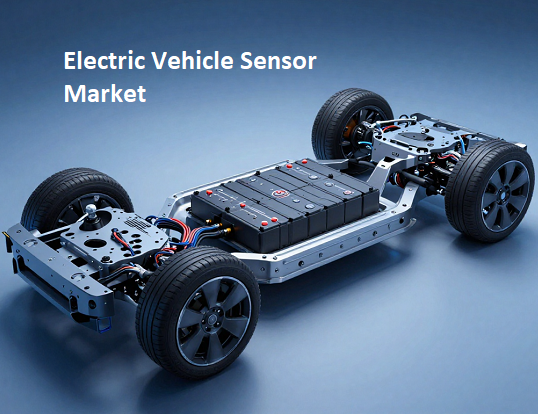
  • Electric Vehicle Sensor Market is expected to grow at a compound annual growth rate of 15.7% through 2033

    The Global Electric Vehicle Sensor Market is projected to reach USD 16.0 billion in 2024 and is expected to grow at a compound annual growth rate of 15.7% through 2033, ultimately reaching an estimated value of USD 59.4 billion. This rapid expansion reflects the accelerating global adoption of electric vehicles and the increasing integration of advanced electronic systems within modern mobility platforms. As automotive manufacturers prioritize energy efficiency, safety, and intelligent connectivity, the electric vehicle sensor market is emerging as a foundational pillar of next-generation transportation.

    Understanding the Electric Vehicle Sensor Market Landscape
    The electric vehicle sensor market encompasses a wide range of sensing technologies integrated into battery electric vehicles, plug-in hybrids, and hybrid electric vehicles. These sensors monitor, measure, and manage critical vehicle parameters such as temperature, pressure, current, position, speed, proximity, and environmental conditions.

    Unlike traditional internal combustion vehicles, electric vehicles rely heavily on electronic control systems and battery management architectures. Sensors act as the “nervous system” of EVs, transmitting real-time data to control units that optimize performance, extend battery life, and enhance safety. From battery health monitoring to advanced driver assistance systems, sensors play an indispensable role in ensuring reliable and efficient operation.

    The sharp growth trajectory of the electric vehicle sensor market reflects the broader electrification trend reshaping the automotive industry. With increasing consumer awareness of environmental sustainability and supportive regulatory frameworks, EV production volumes are rising globally, directly fueling sensor demand.

    Key Growth Drivers Accelerating Market Expansion
    Several structural and technological factors are driving the rapid expansion of the electric vehicle sensor market.

    First, the global shift toward sustainable mobility is significantly boosting electric vehicle adoption. Governments worldwide are implementing stringent emission regulations and offering incentives to promote EV ownership. As EV sales increase, the need for high-performance sensor systems grows proportionally.

    Second, advancements in battery technology require sophisticated monitoring systems. Battery management systems depend on accurate temperature, voltage, and current sensors to ensure safe charging, prevent overheating, and extend battery lifespan. The complexity of these systems elevates sensor demand per vehicle compared to traditional automobiles.

    Third, the growing integration of advanced driver assistance systems enhances sensor deployment. Features such as adaptive cruise control, lane-keeping assistance, collision detection, and automated parking rely on a network of sensors including radar, ultrasonic, and optical devices.

    Fourth, rising consumer expectations for connected and intelligent vehicles are influencing automakers to embed more sensors into EV platforms. Real-time diagnostics, predictive maintenance alerts, and over-the-air software updates depend on precise sensor data.

    Download a Complimentary PDF Sample Report:
    https://dimensionmarketresearch.com/request-sample/electric-vehicle-sensor-market/

    Electric Vehicle Sensor Market is expected to grow at a compound annual growth rate of 15.7% through 2033 The Global Electric Vehicle Sensor Market is projected to reach USD 16.0 billion in 2024 and is expected to grow at a compound annual growth rate of 15.7% through 2033, ultimately reaching an estimated value of USD 59.4 billion. This rapid expansion reflects the accelerating global adoption of electric vehicles and the increasing integration of advanced electronic systems within modern mobility platforms. As automotive manufacturers prioritize energy efficiency, safety, and intelligent connectivity, the electric vehicle sensor market is emerging as a foundational pillar of next-generation transportation. Understanding the Electric Vehicle Sensor Market Landscape The electric vehicle sensor market encompasses a wide range of sensing technologies integrated into battery electric vehicles, plug-in hybrids, and hybrid electric vehicles. These sensors monitor, measure, and manage critical vehicle parameters such as temperature, pressure, current, position, speed, proximity, and environmental conditions. Unlike traditional internal combustion vehicles, electric vehicles rely heavily on electronic control systems and battery management architectures. Sensors act as the “nervous system” of EVs, transmitting real-time data to control units that optimize performance, extend battery life, and enhance safety. From battery health monitoring to advanced driver assistance systems, sensors play an indispensable role in ensuring reliable and efficient operation. The sharp growth trajectory of the electric vehicle sensor market reflects the broader electrification trend reshaping the automotive industry. With increasing consumer awareness of environmental sustainability and supportive regulatory frameworks, EV production volumes are rising globally, directly fueling sensor demand. Key Growth Drivers Accelerating Market Expansion Several structural and technological factors are driving the rapid expansion of the electric vehicle sensor market. First, the global shift toward sustainable mobility is significantly boosting electric vehicle adoption. Governments worldwide are implementing stringent emission regulations and offering incentives to promote EV ownership. As EV sales increase, the need for high-performance sensor systems grows proportionally. Second, advancements in battery technology require sophisticated monitoring systems. Battery management systems depend on accurate temperature, voltage, and current sensors to ensure safe charging, prevent overheating, and extend battery lifespan. The complexity of these systems elevates sensor demand per vehicle compared to traditional automobiles. Third, the growing integration of advanced driver assistance systems enhances sensor deployment. Features such as adaptive cruise control, lane-keeping assistance, collision detection, and automated parking rely on a network of sensors including radar, ultrasonic, and optical devices. Fourth, rising consumer expectations for connected and intelligent vehicles are influencing automakers to embed more sensors into EV platforms. Real-time diagnostics, predictive maintenance alerts, and over-the-air software updates depend on precise sensor data. Download a Complimentary PDF Sample Report: https://dimensionmarketresearch.com/request-sample/electric-vehicle-sensor-market/
    0 Yorumlar 0 hisse senetleri 469 Views 0 önizleme
  • https://www.thereportcubes.com/report-store/uae-advanced-driver-assistance-systems-market
    https://www.thereportcubes.com/report-store/uae-advanced-driver-assistance-systems-market
    WWW.THEREPORTCUBES.COM
    UAE ADAS Market Forecast & Trends 2026–2032 | Report Cubes
    Explore the UAE ADAS Market, projected to grow at a 16.10% CAGR (2026-2032). Valued at USD 392.50 Million in 2025, it's expected to reach USD 1116.50 Million by 2032.
    0 Yorumlar 0 hisse senetleri 224 Views 0 önizleme
  • Precision Glass Molding Market to Reach USD 6.38 Billion by 2030, Fueled by Optical Technology Demand

    Precision glass molding market was estimated at USD 1.02 billion in 2023. According to a new industry analysis, the market is projected to reach USD 6.38 billion by 2030, exhibiting an exceptional compound annual growth rate (CAGR) of 30.00% during the forecast period. This accelerated growth is primarily driven by increasing integration in automotive advanced driver-assistance systems, expanding adoption in consumer electronics, and growing demand for high-performance optical components across multiple technology sectors.

    Purchase the Complete Market Analysis: https://www.24chemicalresearch.com/reports/287122/global-precision-glass-molding-forecast-market-2025-2032-786
    Precision Glass Molding Market to Reach USD 6.38 Billion by 2030, Fueled by Optical Technology Demand Precision glass molding market was estimated at USD 1.02 billion in 2023. According to a new industry analysis, the market is projected to reach USD 6.38 billion by 2030, exhibiting an exceptional compound annual growth rate (CAGR) of 30.00% during the forecast period. This accelerated growth is primarily driven by increasing integration in automotive advanced driver-assistance systems, expanding adoption in consumer electronics, and growing demand for high-performance optical components across multiple technology sectors. Purchase the Complete Market Analysis: https://www.24chemicalresearch.com/reports/287122/global-precision-glass-molding-forecast-market-2025-2032-786
    WWW.24CHEMICALRESEARCH.COM
    Precision Glass Molding Market, Global Outlook and Forecast 2025-2032
    Precision Glass Molding Global Precision Glass Molding market was valued at USD 1016 million in 2023 and is projected to reach USD 6375.25 million by 2030, at a CAGR of 30.00% during the forecast period.
    0 Yorumlar 0 hisse senetleri 375 Views 0 önizleme
Abistem https://abistem.com