


Low Code Development Platform Market Trends Emphasize AI Copilots And Governance Controls
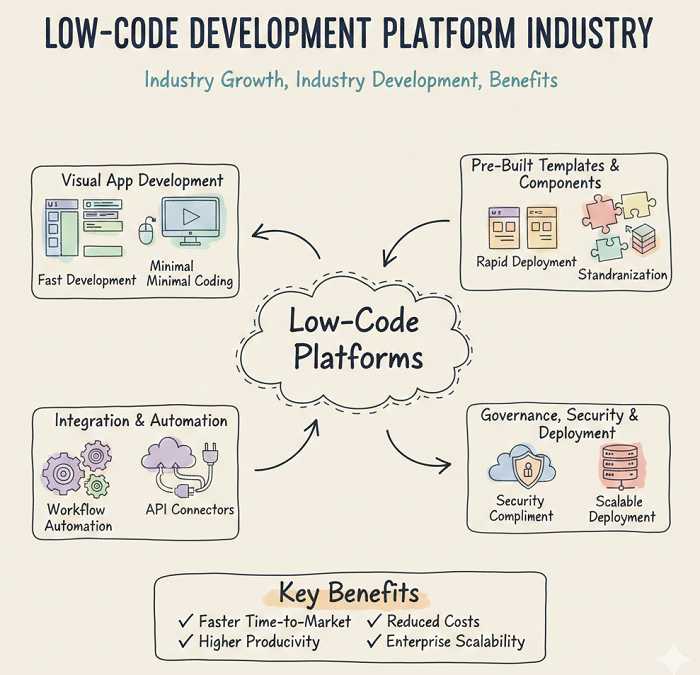
Prominent Low Code Development Platform Market Trends include AI-assisted development, stronger governance, and deeper integration with enterprise systems. AI copilots are emerging to help users generate forms, workflows, and data models from natural-language prompts, reducing time spent on repetitive configuration. However, organizations increasingly demand controls to ensure AI-generated logic is secure, correct, and aligned with policy. Governance trends include approval workflows for publishing, centralized policy enforcement, component reuse standards, and environment separation for dev, test, and production. These controls help enterprises expand citizen development safely. Another trend is composable development, where low code handles orchestration and UI while custom microservices provide complex business logic. This approach reduces platform limitations and supports sophisticated applications. Observability is also rising as a trend, with built-in monitoring, logs, and performance analytics required for production operations. These features reflect the shift of low code from experimentation to critical workloads. The market is moving toward platforms that provide speed without sacrificing reliability.
Integration trends are becoming more significant as enterprises standardize around core systems. Buyers increasingly expect broad connector catalogs, strong API management, and event-driven automation to connect workflows across SaaS and on-prem systems. Data trends include tighter linkage to warehouses and analytics tools, enabling real-time dashboards and operational reporting. Some platforms are adding integrated data layers, but organizations remain cautious about duplicating master data without clear ownership. Security trends include stronger identity integration, SSO, encryption, and granular access controls, along with audit-ready logging. Another trend is mobile-first development, supporting responsive interfaces and offline use cases for field workers. Template marketplaces and reusable component ecosystems are expanding, helping teams build faster and standardize UI and process patterns. Training and enablement programs are also trending upward, as enterprises invest in centers of excellence to scale adoption. These trends reinforce that low code success depends on platform capabilities plus organizational process. Vendors that support both technology and enablement will benefit.
Industry adoption trends show low code expanding beyond IT into operations, finance, and customer experience teams. Use cases increasingly include case management, onboarding portals, partner workflows, and service request applications. In regulated industries, adoption grows where platforms provide auditability and controlled development pathways. Organizations are also pairing low code with process mining to identify bottlenecks, then rapidly implement workflow improvements. RPA integration is another trend, allowing teams to automate legacy systems that lack APIs. Multi-cloud and hybrid deployment trends remain relevant where data residency and latency requirements apply. Platforms are also improving developer tooling to appeal to professional engineers, including reusable component development, Git-based versioning, and automated testing. These improvements help reduce the perceived tradeoff between speed and engineering discipline. Over time, low code is becoming part of standard enterprise engineering toolchains. The trendline points toward convergence: low code and traditional development working together.
Trends also highlight challenges that shape best practices. Application sprawl and inconsistent quality remain risks, driving further emphasis on governance frameworks and architecture standards. Organizations increasingly define “guardrails” to limit where citizen developers can write custom logic or access sensitive data. Another trend is measuring outcomes, with teams tracking cycle time, backlog reduction, and process KPIs to justify platform investment. Vendor differentiation may increasingly depend on transparency around AI features, security posture, and portability. Looking ahead, low code trends suggest continued expansion into mission-critical domains as platforms mature. Buyers will prefer vendors that combine AI productivity with predictable operations, clear controls, and strong integration. The market will reward platforms that help enterprises scale development responsibly. As the category matures, trends will focus less on building demos and more on sustaining reliable applications across years. That shift will define which platforms become enterprise standards.
Top Trending Reports:
Point To Point Microwave Antenna Market

 Kiswahili
 Arabic
 French
 Spanish
 Portuguese
 Deutsch
 Turkish
 Dutch
Dutch
 Italiano
 Russian
 Romaian
 Portuguese (Brazil)
 Greek
Greek
