


Understanding the Walmart Org Chart: Structure, Strategy, and Practical Insights
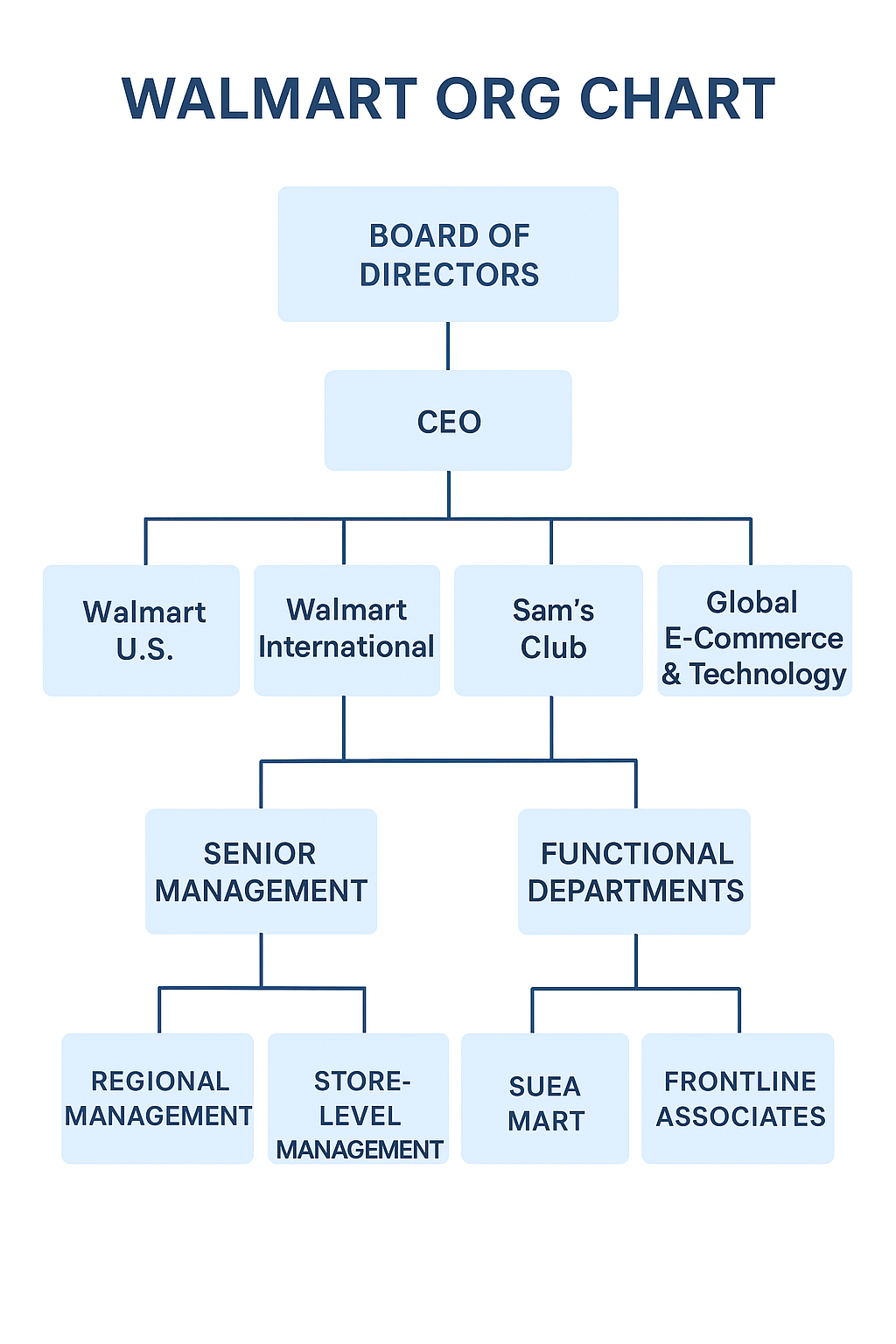
When people search for the term “Walmart org chart,” they’re typically looking for an overview of how one of the world’s largest retailers organizes its leadership, operations, and workforce. For a company operating thousands of stores, employing more than two million people, and managing a global supply chain, having a clear organizational structure isn’t just helpful—it's essential.
This article breaks down Walmart’s organizational chart, explains why it matters, and offers insights that individuals and businesses can apply to their own organizational planning. At the end, you’ll find a helpful FAQ section addressing commonly searched questions related to the Walmart org chart.
Why the Organizational Structure Matters
Walmart’s size and global presence create unique challenges that demand a sophisticated organizational structure. Unlike small firms where communication and decision-making can occur informally, Walmart relies on well-defined reporting lines and specialized functional areas to coordinate its operations effectively.
A well-designed org chart helps Walmart:
-
Streamline decision-making by clarifying who is responsible for what.
-
Manage large-scale logistics across stores, fulfillment centers, and countries.
-
Balance central control with local flexibility, ensuring national standards while allowing stores to address regional needs.
-
Support specialization, giving departments such as finance, HR, technology, and supply chain the expertise they need to operate efficiently.
-
Maintain accountability throughout every level of the company.
Understanding Walmart’s org chart gives insight into how the company maintains consistency, efficiency, and customer focus at a massive scale.
The Key Layers of the Walmart Org Chart
The Walmart organizational structure can be visualized in several main layers, ranging from the boardroom down to store-level employees. Below is an overview of these layers and the purpose each serves.
1. Board of Directors
At the top sits the Board of Directors. They are responsible for governance, oversight, and long-term strategic direction. This group ensures that Walmart stays aligned with its mission, operates responsibly, and adapts to major economic and industry changes.
2. CEO and Executive Leadership
The CEO leads Walmart’s entire global operation and reports directly to the Board. Beneath the CEO is the executive leadership team or C-suite, which includes roles such as:
-
Chief Financial Officer
-
Chief People Officer
-
Chief Technology or Digital Officer
-
Chief Merchandising Officer
-
Chief Legal Officer
These executives oversee core corporate functions and work together to guide Walmart’s long-term strategy.
3. Divisional Leadership
Walmart operates multiple major business units, each with its own leadership structure:
-
Walmart U.S. – Oversees domestic stores and retail operations
-
Walmart International – Manages global retail operations across various countries
-
Sam’s Club – Handles membership-based wholesale club operations
-
Global E-Commerce & Technology – Focuses on online retail, digital transformation, and tech infrastructure
This division-based structure allows Walmart to adapt strategies to the unique needs of different markets and customer bases.
4. Senior Management and Functional Departments
Below the divisional heads are senior vice presidents, vice presidents, and regional leaders who manage functional areas such as:
-
Finance
-
Human Resources
-
Supply Chain and Logistics
-
Marketing
-
Merchandising
-
Technology and Data
-
Corporate Affairs
This layer translates high-level strategy into operational plans and oversees execution across stores and regions.
5. Regional, District, and Market-Level Management
Walmart’s geographic management structure ensures that stores receive support tailored to their specific region.
These leaders ensure consistency in operations, compliance, and performance across clusters of stores.
6. Store-Level Management
Each store has its own internal hierarchy that typically includes:
-
Store Manager
-
Assistant Store Managers
-
Department Managers
-
Team Leads
This level focuses on daily operations, customer service, staffing, and store performance.
7. Frontline Associates
These employees are the backbone of Walmart’s daily operations. They include:
-
Cashiers
-
Sales associates
-
Stockers
-
Customer service representatives
-
Online order pickers and fulfillment staff
This final layer directly interacts with customers and ensures the store experience runs smoothly.
Walmart’s Organizational Style: A Hybrid Structure
Walmart uses a hybrid organizational structure, often described as a blend of:
1. Hierarchical Structure
The traditional top-down model ensures clear authority and reporting relationships, especially within store-level operations.
2. Functional Structure
Corporate functions such as finance, IT, HR, and logistics are centralized, giving Walmart the advantages of specialization and consistency.
3. Divisional Structure
Each major business unit—such as Walmart U.S., International, and Sam’s Club—functions semi-independently, allowing tailored strategies for different markets.
Combining these approaches allows Walmart to maintain efficiency and specialization while still being flexible and responsive to local conditions.
How Walmart’s Org Chart Reflects Its Business Strategy
Organizational structure is never random—it reflects the company’s priorities and business strategy. For Walmart, these include:
-
Operating at massive scale
-
Maintaining low prices through efficient logistics
-
Competing in both physical and digital retail
-
Ensuring consistent customer experience across regions
-
Supporting global growth while maintaining strong U.S. operations
Walmart’s hybrid org chart supports these priorities by centralizing essential functions while giving divisions room to innovate and adjust to local needs.
Lessons Other Organizations Can Learn from Walmart
Companies of any size can learn from Walmart’s approach:
1. Align structure with strategy
Your org chart should support—not hinder—your goals.
2. Balance centralization and decentralization
Standardize where it makes sense; allow flexibility where needed.
3. Invest in specialized departments
Areas like technology, HR, or supply chain can benefit from centralized expertise.
4. Keep reporting lines clear
Large or small, every organization benefits from clarity in roles and responsibilities.
5. Adapt your structure over time
As industries evolve, so should your organizational design. Walmart frequently updates its structure to support growth in technology and e-commerce.
Potential Challenges in Walmart’s Org Chart
Even well-designed structures come with trade-offs. Walmart’s hybrid structure can present challenges such as:
-
Overlapping responsibilities in a matrix system
-
Slower decision-making due to cross-functional coordination needs
-
Communication complexity across multiple layers
-
Balancing global standards with local needs
However, these difficulties are often unavoidable in large multinational organizations.
Why Understanding the Walmart Org Chart Matters
People may examine Walmart’s org chart for many reasons:
-
Job seekers exploring career paths
-
Students and researchers studying organizational behavior
-
Business leaders benchmarking their own structures
-
Analysts and investors assessing leadership dynamics
-
Employees trying to understand how divisions and reporting lines function
Studying Walmart’s structure offers a clear window into how large corporations manage complexity and scale successfully.
FAQ: Walmart Org Chart
1. What does the Walmart org chart include?
It typically shows the hierarchy from the Board of Directors to the CEO, senior corporate leadership, divisional heads, functional departments, regional managers, store management, and frontline staff.
2. What type of structure does Walmart use?
Walmart uses a hybrid structure combining hierarchical, functional, and divisional elements to manage global operations effectively.
3. Why is Walmart’s organizational structure so complex?
Because the company operates internationally, manages numerous business units, and employs millions of workers, requiring a structure that balances efficiency with flexibility.
4. Does Walmart update its org chart over time?
Yes. As business needs change—especially in technology and e-commerce—Walmart reorganizes departments and leadership roles to stay competitive.
5. What are common challenges within Walmart’s structure?
Challenges may include overlapping reporting lines, communication complexity, and slower decision-making due to the matrix elements of the structure.

 English
 Kiswahili
 Arabic
 French
 Spanish
 Portuguese
 Deutsch
 Dutch
Dutch
 Italiano
 Russian
 Romaian
 Portuguese (Brazil)
 Greek
Greek
