


How Funnel Builders Work Behind the Scenes
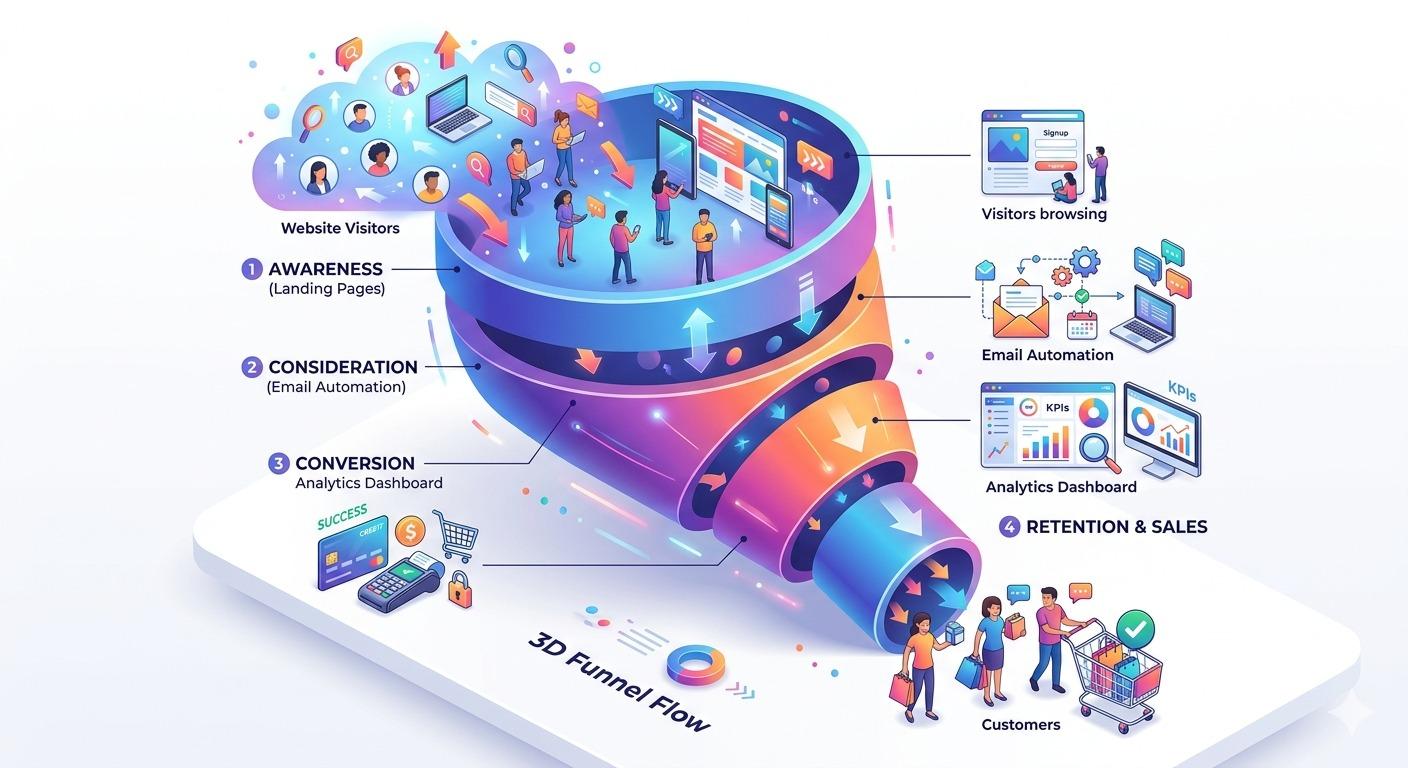
A funnel page may look simple on the front end, but a lot happens in the background before a visitor ever clicks a button.
That hidden side is what confuses many beginners. You open a funnel builder, see templates, drag a few blocks into place, and publish a page. From the outside, the process feels easy. Still, one question usually stays in the back of your mind: what is the software actually doing behind the scenes?
That is where things start to make sense.
How funnel builders work behind the scenes is not as mysterious as it first seems. These tools are built to connect several jobs into one system. They help create pages, collect visitor data, send people to the next step, trigger follow-up actions, and track what happens at each stage. Instead of making you stitch everything together by hand, the builder handles the structure in the background.
That does not mean funnel builders are magical. They are simply organized systems. Each part has a role. One part loads the page. Another stores form entries. Another triggers an email or moves the visitor to checkout. Another records conversions and visits. Once you see those parts clearly, the tool becomes much easier to use.
What a Funnel Builder Actually Does
A funnel builder is a tool that helps you create and manage the path a visitor follows from first click to final action.
That action could be a sale, a lead form, an email signup, a booked call, or a free trial. The builder gives you one place to set up those steps without needing to code each part from scratch.
On the surface, most funnel builders look like page editors. You drag in headlines, buttons, images, forms, videos, and testimonials. Then you style the layout and publish it. That is the visible part.
Behind the scenes, the builder is doing more than page design.
It is storing page settings, saving block layouts, loading scripts, linking forms to databases, routing button clicks, and assigning actions to user behavior. If someone enters an email address, the system may send that data to a contact list. If someone buys a product, the builder may redirect that person to a thank-you page, log the purchase, and trigger an email sequence.
That is why funnel builders feel powerful. They combine design, flow control, automation, and tracking inside one platform. Instead of using separate tools for every step, you manage the path in one place.
This is also why the word “builder” can be slightly misleading. You are not only building pages. You are building a process.
The Front End and the Back End of a Funnel
To understand funnel builders better, it helps to separate the front end from the back end.
The front end is the part visitors see. This includes the landing page, sales page, opt-in form, checkout page, thank-you page, pop-up, and design elements. It is the visual experience.
The back end is the hidden system that supports those pages. This is where the tool stores settings, handles submissions, tracks visits, manages contacts, processes actions, and triggers automations.
Think of a restaurant. The dining area is the front end. The kitchen, order flow, inventory, and staff process are the back end. The customer sees the meal and service. The team sees the real system underneath.
A funnel builder works in a similar way.
When a visitor clicks a button on a landing page, the front end shows the button. The back end decides what that click should do. Maybe the visitor moves to checkout. Maybe a form opens. Maybe a tracking event gets logged. Maybe all three happen together.
This split matters because beginners often focus only on what looks good. Design is important, but the process behind the design matters just as much. A page can look polished and still fail if the form is broken, the tracking does not work, or the follow-up never triggers.
That is why a good funnel builder is more than a design tool. It is a visual layer sitting on top of a working system.
Read More:- https://topreviewsprint.com/how-funnel-builders-work-behind-scenes/

 English
 Kiswahili
 Arabic
 French
 Spanish
 Portuguese
 Deutsch
 Turkish
 Dutch
Dutch
 Russian
 Romaian
 Portuguese (Brazil)
 Greek
Greek
