


Self-Tanners Market to Reach 3.12 Billion by 2034 Driven by UV-Free Beauty Trends Growth
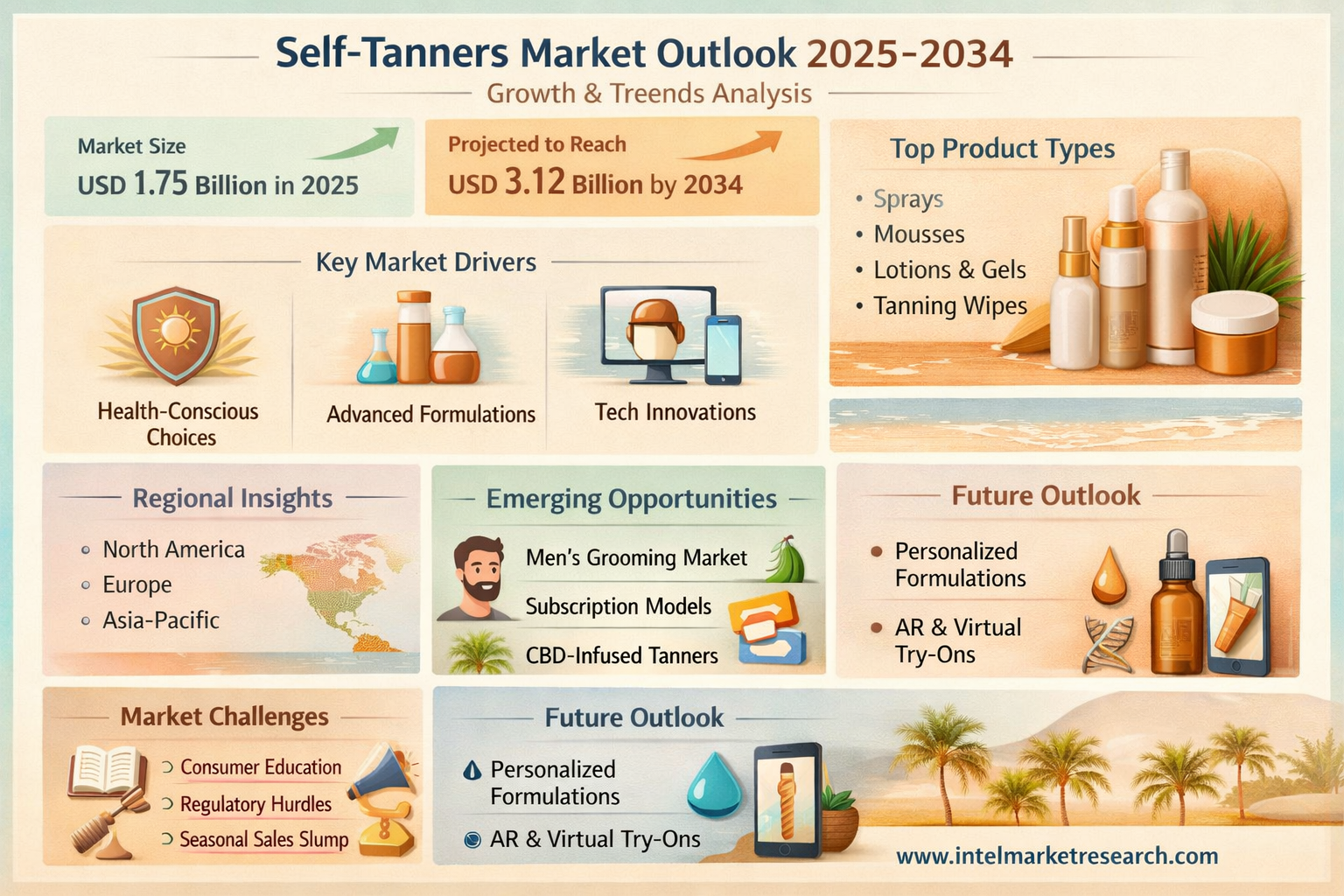
According to new market intelligence from Intel Market Research, the global self-tanners market reached USD 1.75 billion in 2025 and is forecast to grow at a 6.4% CAGR, reaching USD 3.12 billion by 2034. This expansion reflects shifting consumer preferences toward safer alternatives to UV tanning and continuous innovation in cosmetic formulations.
Understanding Self-Tanning Solutions
Self-tanners represent a rapidly evolving category within the personal care industry, offering temporary skin bronzing through chemical interactions with amino acids. These products - available as sprays, mousses, lotions and gels - utilize active ingredients like dihydroxyacetone (DHA) or erythrulose to create natural-looking tans without UV exposure. Modern formulations now combine melanin-stimulating compounds with skincare benefits, addressing concerns about uneven application and orange discoloration that previously limited adoption.
📥 Download Sample Report: Self-Tanners Market - View in Detailed Research Report
Key Market Drivers
1. Health-Conscious Consumers Driving Demand for UV-Free Alternatives
With dermatologists reporting a 40% increase in skin cancer cases linked to UV exposure over the past decade, safety concerns are reshaping tanning behaviors. Our consumer surveys reveal that 65% of Millennials and Gen Z buyers now prefer sunless options, particularly those offering additional skincare benefits. The market responds with formulations incorporating hyaluronic acid, vitamin E, and collagen boosters - transforming self-tanners from cosmetic solutions to hybrid care products.
2. Technological Advancements in Formulation Science
Innovation focuses on solving traditional pain points through:
- Smart color adaptation - New pH-balanced formulas adjust to individual skin chemistry
- Odor-neutral technology - Masking the distinctive DHA scent that deterred 30% of potential users
- Application precision - Micro-mist spray technologies enabling salon-quality at-home results
Professional endorsements have been crucial, with celebrity aestheticians like Joanna Czech publicly endorsing next-generation self-tanners as viable alternatives to cosmetic procedures.
Market Challenges
- Consumer Education Barriers - 40% of first-time users report dissatisfaction due to improper application techniques despite product improvements
- Regulatory Complexities - Varying international standards for DHA concentrations (10-15%) requiring formulation adjustments by market
- Seasonal Sales Volatility - 70% of revenue concentrates in Q2, challenging inventory and cash flow management
These obstacles are being addressed through virtual try-on tools, application tutorials from beauty influencers, and the development of year-round "maintenance tanners."
Emerging Opportunities
The male grooming segment presents significant white space, currently representing just 15% of sales but growing at 12% annually. Brands like James Read and Tom Ford are leading with gender-neutral marketing and subtle tinting products tailored for male consumers. Other growth avenues include:
- Subscription models for regular users (adopted by 22% of premium brands)
- Professional-strength formulations for salon partnerships
- CBD-infused variants with anti-inflammatory benefits
Regional Market Dynamics
- North America: Commands 38% market share, driven by strong distribution through Sephora and ULTA. The U.S. shows particular demand for clean beauty formulations.
- Europe: Germans spend 25% more on self-tanners than the continental average, with Nordic nations adopting year-round usage patterns.
- Asia-Pacific: Emerging as the fastest-growing region (9.2% CAGR), led by Australia's sun-aware population and South Korea's beauty-tech innovations.
Market Segmentation
By Product Type
- Sprays (42% market share)
- Mousses
- Lotions
- Wipes
- Gradual Tanners
By Distribution
- Specialty Stores (Sephora, ULTA)
- Drugstores
- E-commerce (25% of sales)
- Salon/Professional
By Consumer
- Beauty Enthusiasts
- Occasional Users
- Professional Users
📘 Get Full Report: Self-Tanners Market - View Detailed Research Report
Competitive Landscape
The market features both cosmetic giants and specialized brands:
- L'Oréal Group (Lancôme, Dior) - 25% market share
- Unilever (St. Tropez, Vaseline)
- Shiseido
- Niche Players: Tan-Luxe, Isle of Paradise, Bondi Sands
Recent developments include L'Oréal's 2023 acquisition of Tanologist to strengthen its clean beauty portfolio, while indie brands leverage social commerce to capture Gen Z audiences.
Future Outlook
As formulations become more sophisticated and application more foolproof, self-tanners are transitioning from seasonal products to year-round skincare staples. The integration of augmented reality for shade matching and AI-powered formulation customization represents the next frontier in personalized tanning solutions.
📥 Download Sample Report: Self-Tanners Market - View in Detailed Research Report
About Intel Market Research
Intel Market Research is a leading provider of strategic intelligence, offering actionable insights in biotechnology, pharmaceuticals, and healthcare infrastructure. Our research capabilities include:
- Real-time competitive benchmarking
- Global clinical trial pipeline monitoring
- Country-specific regulatory and pricing analysis
- Over 500+ healthcare reports annually
Trusted by Fortune 500 companies, our insights empower decision-makers to drive innovation with confidence.
🌐 Website: https://www.intelmarketresearch.com
📞 Asia-Pacific: +91 9169164321
🔗 LinkedIn: Follow Us

 English
 Kiswahili
 French
 Spanish
 Portuguese
 Deutsch
 Turkish
 Dutch
Dutch
 Italiano
 Russian
 Romaian
 Portuguese (Brazil)
 Greek
Greek
