Jaw crushers and mobile crushing plants are core crushing equipment used in mining, construction, infrastructure and other industries. Due to differences in structural characteristics and functional positioning, their application scenarios vary significantly. Starting from the core features of the equipment, this article elaborates on their typical application scenarios and compares the key differences to help users accurately distinguish their suitable working conditions.
Jaw crusher, commonly known as “jaw crusher”, is the core equipment of fixed crushing production lines. It features a simple structure, high compressive strength, and suitability for primary and secondary crushing. It is mainly used to process high-hardness bulk materials such as granite, basalt, ore, etc. It must work with feeders, conveyors, screening equipment and other machines to form a complete production line and cannot operate independently on the move. Its applications focus on fixed sites, large-scale and long-term crushing demands.
Primary crushing for metallic and non-metallic oresAt mining sites including iron ore, copper ore, gold ore, limestone quarry, quartz mine, etc., the jaw crusher serves as the first-stage crushing equipment, reducing large blasted ore (usually 500–1500 mm) to medium-sized particles of 100–300 mm, providing qualified feed for subsequent cone crushers (secondary and fine crushing), ball mills (grinding) and other equipment.
Example: After limestone quarrying, a PE 1200×1500 jaw crusher reduces 1200 mm raw stone to below 200 mm, which is then sent to a cone crusher for secondary crushing to produce construction aggregates.
Pretreatment for mineral processingIn mineral processing, the jaw crusher first crushes large raw ore to prevent blockage in downstream equipment caused by oversized feed, especially for hard rock mines with hardness above 150 MPa, such as granite and basalt quarries.
Fixed aggregate crushing plantsIn production bases for construction aggregates (crushed stone, manufactured sand), the jaw crusher acts as a primary crusher, processing river pebbles, construction waste, waste rock and other materials. Combined with impact crushers (shaping) and sand making machines, it produces aggregates conforming to GB/T 14685-2022 Pebbles and Gravels for Construction, used in concrete, asphalt pavements, wall materials, etc.
Example: A building materials factory uses a jaw crusher to crush 500 mm river pebbles to 150 mm, then shapes them into 5–31.5 mm crushed stone via an impact crusher for surrounding real estate projects.
Fixed crushing zones for large infrastructureIn large-scale projects such as highways, railways, hydropower stations, etc., if long-term crushing demand (over 1 year) exists on site, a fixed crushing workshop is built. The jaw crusher processes excavated earth and rock (such as tunnel muck, subgrade rock) into reusable backfill or aggregates to reduce transportation costs.
Example: During a hydropower station construction, a jaw crusher crushes 800 mm basalt tunnel muck from dam excavation for subgrade backfill and concrete aggregates.
Crushing large industrial waste residuesFor high-hardness and large-sized wastes such as steel slag and blast furnace slag from metallurgy, or large waste catalyst carriers from the chemical industry, primary crushing by a jaw crusher is required before entering subsequent fine crushing or sorting systems to realize resource recovery (e.g., steel recovery from steel slag, cement admixture from blast furnace slag).
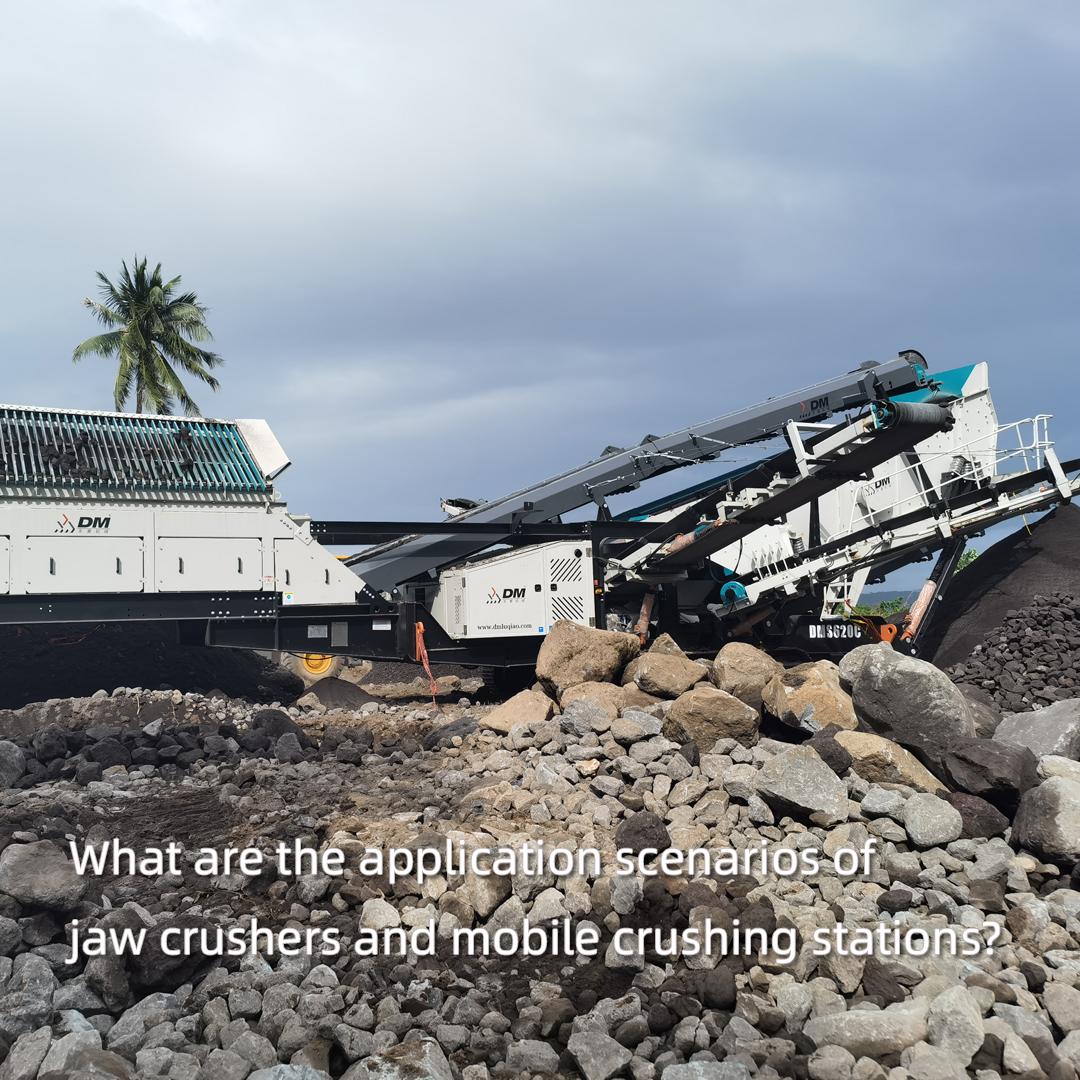
A mobile crushing plant is an integrated mobile crushing unit that integrates jaw/impact/cone crushers, feeders, screens, conveyors and other components onto one or more mobile chassis (crawler or wheel type). It can be transferred flexibly according to operational needs without installing a fixed production line. Its core advantages are strong mobility, fast relocation, and adaptability to scattered or temporary crushing tasks. It is mainly applied in scenarios with scattered sites, short construction periods and difficult material transportation.





 English
 Kiswahili
 Arabic
 French
 Spanish
 Portuguese
 Deutsch
 Turkish
 Dutch
Dutch
 Russian
 Romaian
 Portuguese (Brazil)
 Greek
Greek