


SPARK Matrix Industrial Edge AI Solutions Redefining Process Intelligence
Introduction – Why Industrial Edge AI Matters Now
Manufacturing and process industries are under intense pressure to improve operational efficiency, resilience, and sustainability while managing growing data volumes from connected assets. Centralized cloud and data center models alone can no longer meet the latency, reliability, and security demands of modern plants. Industrial Edge AI Solutions have emerged as a critical enabler, bringing intelligence closer to machines and processes where decisions must happen in milliseconds, not minutes.
By combining edge computing with advanced analytics and AI, these solutions are redefining how industrial enterprises operate, compete, and scale in a digital-first world.
Market / Industry Overview
Industrial Edge AI Solutions are software-first platforms designed to connect, process, and analyze operational data at or near industrial assets. Unlike generic edge computing stacks, these solutions are purpose-built for plant-level deployment and industrial workloads. They tightly integrate data connectivity, real-time processing, AI-driven analytics, and security into a unified environment.
This study focuses specifically on Industrial Edge AI Solutions developed by core process automation vendors. These offerings are deeply embedded into control systems, historians, and plant infrastructure, enabling seamless data flow from the shop floor to enterprise and cloud environments. Vendors such as Siemens, ABB, Schneider Electric, Rockwell Automation, and Emerson are leading this evolution by embedding AI and analytics directly into their automation ecosystems.
For businesses, this shift is strategic. It enables faster decisions, higher uptime, improved safety, and reduced dependence on centralized IT infrastructure.
Key Challenges Businesses Face
Despite strong interest, enterprises face several challenges when adopting Industrial Edge AI Solutions:
- Latency-sensitive operations: Cloud-only analytics often fail to meet real-time operational requirements.
- Data silos between IT and OT: Fragmented architectures limit visibility and insight.
- Security concerns at the edge: Distributed environments increase the attack surface.
- Scalability and lifecycle management: Managing hundreds of edge nodes across plants is complex.
- Skill gaps: OT teams may lack AI and analytics expertise.
These challenges are accelerating demand for integrated, vendor-supported edge AI platforms.
Key Trends & Innovations
The Industrial Edge AI market is evolving rapidly, driven by several key innovations:
- AI at the edge: Machine learning models for anomaly detection, predictive maintenance, and quality inspection are now deployed directly on edge nodes.
- Containerized and microservices architectures: These simplify application deployment and updates across distributed plants.
- Hybrid edge-to-cloud models: Edge systems handle real-time decisions while the cloud supports training, optimization, and fleet-level analytics.
- Built-in cybersecurity: Zero-trust architectures, secure boot, and encrypted data pipelines are becoming standard.
- Automation vendor ecosystems: Native integration with PLCs, DCS, SCADA, and historians accelerates adoption.
Together, these trends are making Industrial Edge AI Solutions more accessible, scalable, and business-ready.
Benefits & Business Impact
When implemented effectively, Industrial Edge AI delivers measurable business value:
- Faster decision-making: Real-time analytics reduce response times from minutes to milliseconds.
- Improved asset performance: Predictive insights minimize downtime and extend equipment life.
- Lower operational costs: Reduced data transmission and cloud dependency optimize infrastructure spend.
- Enhanced security and compliance: Sensitive operational data stays on-site.
- Scalable innovation: New use cases can be rolled out plant by plant.
For CXOs and technology buyers, Industrial Edge AI Solutions represent a high-ROI investment aligned with digital transformation and Industry 4.0 goals.
Use Cases and Real World Examples
Common use cases across process and discrete industries include:
- Predictive maintenance: Detecting early signs of equipment failure using vibration and process data.
- Quality monitoring: AI-based visual inspection and process optimization at production lines.
- Energy optimization: Real-time energy analytics to reduce consumption and emissions.
- Safety monitoring: Edge AI models identifying unsafe conditions or behaviors instantly.
- Production optimization: Closed-loop control improvements driven by local analytics.
In refineries, chemical plants, and power generation facilities, edge AI enables continuous optimization even in remote or connectivity-constrained environments.
How Organizations Can Choose the Right Solution
Selecting the right Industrial Edge AI platform requires a structured approach:
- Evaluate native integration: Prioritize solutions tightly integrated with existing automation systems.
- Assess scalability and manageability: Look for centralized orchestration and lifecycle management.
- Security by design: Ensure built-in cybersecurity tailored for OT environments.
- Ecosystem and roadmap: Choose vendors with strong partner ecosystems and long-term vision.
- Proven industrial use cases: Favor platforms validated in real production environments.
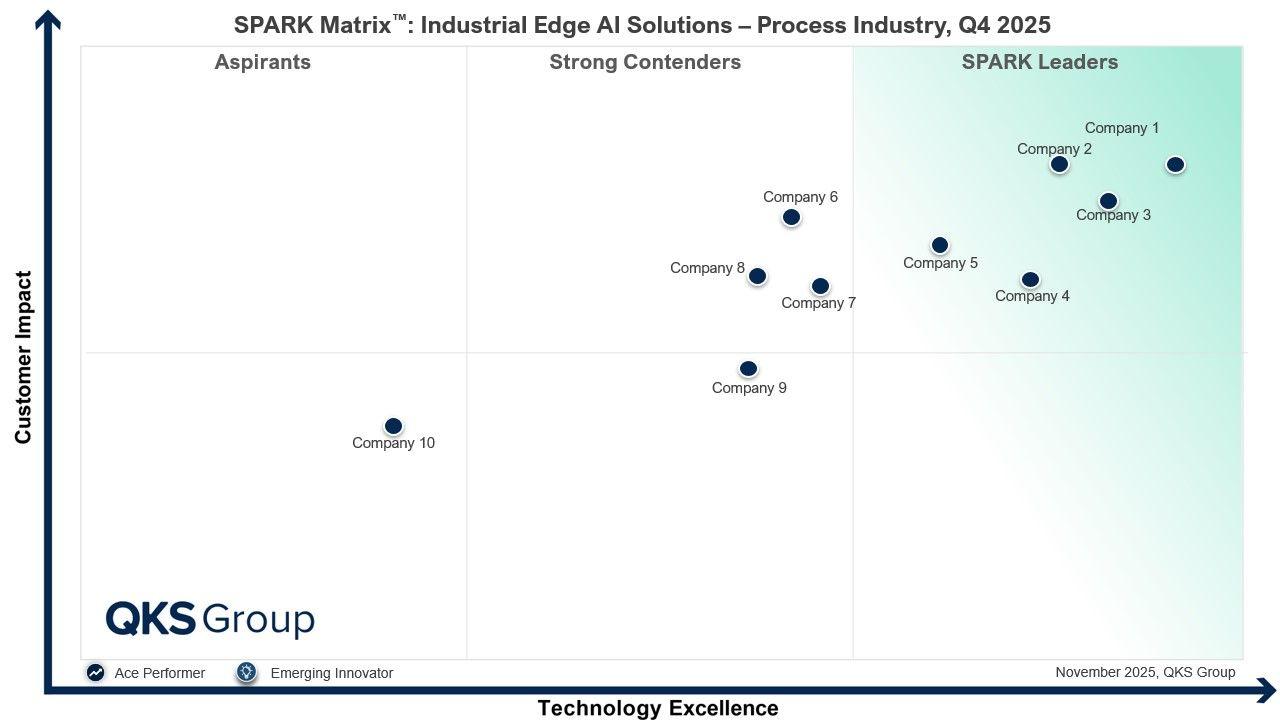
Independent evaluations such as the SPARK Matrix™ from QKS Group help buyers benchmark vendors on technology excellence and customer impact.
Future Outlook 2025–2028
Between 2025 and 2028, Industrial Edge AI Solutions will move from pilot projects to large-scale deployments. AI models will become more autonomous, adaptive, and context-aware. Integration between edge, enterprise, and cloud platforms will deepen, enabling closed-loop optimization across the value chain. Sustainability and regulatory compliance will further accelerate adoption, especially in energy-intensive industries.
Vendor-led platforms will dominate as enterprises seek standardized, secure, and supported solutions rather than custom-built stacks.
Conclusion
Industrial enterprises are entering a phase where intelligence at the edge is no longer optional. Industrial Edge AI Solutions empower organizations to act on data in real time, improve resilience, and unlock new levels of efficiency and safety. For technology leaders and decision-makers, investing in industrial-grade edge AI platforms is a strategic step toward building agile, future-ready operations.

 Kiswahili
 Arabic
 French
 Spanish
 Portuguese
 Deutsch
 Turkish
 Dutch
Dutch
 Italiano
 Russian
 Romaian
 Portuguese (Brazil)
 Greek
Greek
