


Industrial IoT Platforms Redefined Insights from SPARK Matrix™ 2025
Introduction: Why This Moment Matters
The Industrial IoT platform market is at an inflection point. What began as a way to connect machines and collect sensor data is rapidly evolving into a strategic foundation for autonomous, AI-driven industrial operations. Enterprises today face unprecedented pressure to improve productivity, resilience, and sustainability—while managing increasingly complex hybrid IT–OT environments.
At the center of this transformation is the rise of the Unified Namespace (UNS), open architectures, and AI-native platforms that turn fragmented industrial data into real-time, actionable intelligence. For manufacturers, energy providers, and asset-intensive industries, this is no longer an experiment. It is a business imperative.
Click Here For More Information:https://qksgroup.com/market-research/spark-matrix-industrial-internet-of-things-iiot-platform-q2-2025-8736
Market / Industry Overview
The Industrial IoT platform market enables organizations to connect industrial assets, ingest operational data, contextualize it, and drive insights across production, supply chain, and enterprise systems. These platforms sit at the intersection of operational technology (OT) and information technology (IT), acting as a digital backbone for smart factories and connected operations.
Historically, IIoT platforms focused on device connectivity and data ingestion. Today, their role is far broader. Modern platforms are becoming:
- Real-time data orchestration layers
- AI-enabled decision engines
- Foundations for digital twins and autonomous operations
Industries such as manufacturing, energy, utilities, oil & gas, and logistics increasingly rely on IIoT platforms to support Industry 4.0 initiatives and large-scale digital transformation programs.
Key Challenges Businesses Face
Despite strong adoption momentum, enterprises encounter several obstacles:
- IT–OT silos: Disconnected systems limit data visibility and cross-functional insights
- Proprietary architectures: Vendor lock-in restricts flexibility and innovation
- Data overload: Massive data volumes without proper context reduce value
- Scalability constraints: Pilots succeed, but enterprise-wide rollouts struggle
- Security concerns: Expanding attack surfaces across connected assets
These challenges are pushing buyers to rethink platform strategies and demand architectures designed for scale, openness, and intelligence.
Connect With Our Analyst:https://qksgroup.com/analyst-briefing?analystId=86&reportId=8736
Key Trends & Innovations Shaping the Market
Unified Namespace (UNS) as a Core Enabler
UNS is emerging as a transformative architectural model. By creating a centralized, real-time data layer, UNS eliminates traditional data silos and enables seamless interoperability between IT and OT systems. This allows stakeholders—from plant operators to enterprise leaders—to access a single source of truth.
Open, Containerized Architectures
Vendors are moving away from monolithic platforms toward:
- Microservices-based designs
- Containerized deployments
- API-first interoperability
This modularity supports hybrid and multi-cloud environments while enabling faster innovation cycles.
AI-Native Industrial Platforms
Advanced platforms embed AI and machine learning directly into the data pipeline. Use cases include:
- Predictive and prescriptive maintenance
- Autonomous process optimization
- Anomaly detection and root cause analysis
The Industrial IoT platform market is shifting from “monitor and inform” to “predict and act.”
Sustainability and Energy Intelligence
IIoT platforms increasingly support ESG goals by tracking energy consumption, emissions, and resource efficiency—turning sustainability into a measurable, optimizable outcome.
Benefits & Business Impact
Enterprises investing in next-generation IIoT platforms realize tangible business value:
- Higher operational efficiency: Reduced downtime and optimized asset utilization
- Improved ROI: Faster time-to-value through reusable data models and APIs
- Enterprise scalability: Consistent performance from pilot to global rollout
- Enhanced security: Centralized governance and zero-trust architectures
- Data-driven growth: New digital services and outcome-based business models
Use Cases and Real-World Examples
- Smart Manufacturing: Real-time production monitoring integrated with ERP and MES systems to improve yield and quality
- Predictive Maintenance: AI-driven models detect failures before they occur, reducing unplanned outages
- Energy Optimization: Continuous monitoring of energy usage across facilities to lower costs and emissions
- Supply Chain Visibility: Asset tracking and condition monitoring improve logistics reliability
These use cases demonstrate how IIoT platforms are becoming mission-critical enterprise systems.
How Organizations Can Choose the Right Solution
Selecting the right IIoT platform requires a strategic lens. Decision-makers should evaluate:
- Architecture openness: Support for UNS, APIs, and industry standards
- AI and analytics maturity: Built-in intelligence versus bolt-on tools
- Deployment flexibility: Edge, on-premises, cloud, and hybrid support
- Ecosystem strength: Partner integrations and developer enablement
- Security and governance: End-to-end visibility and policy control
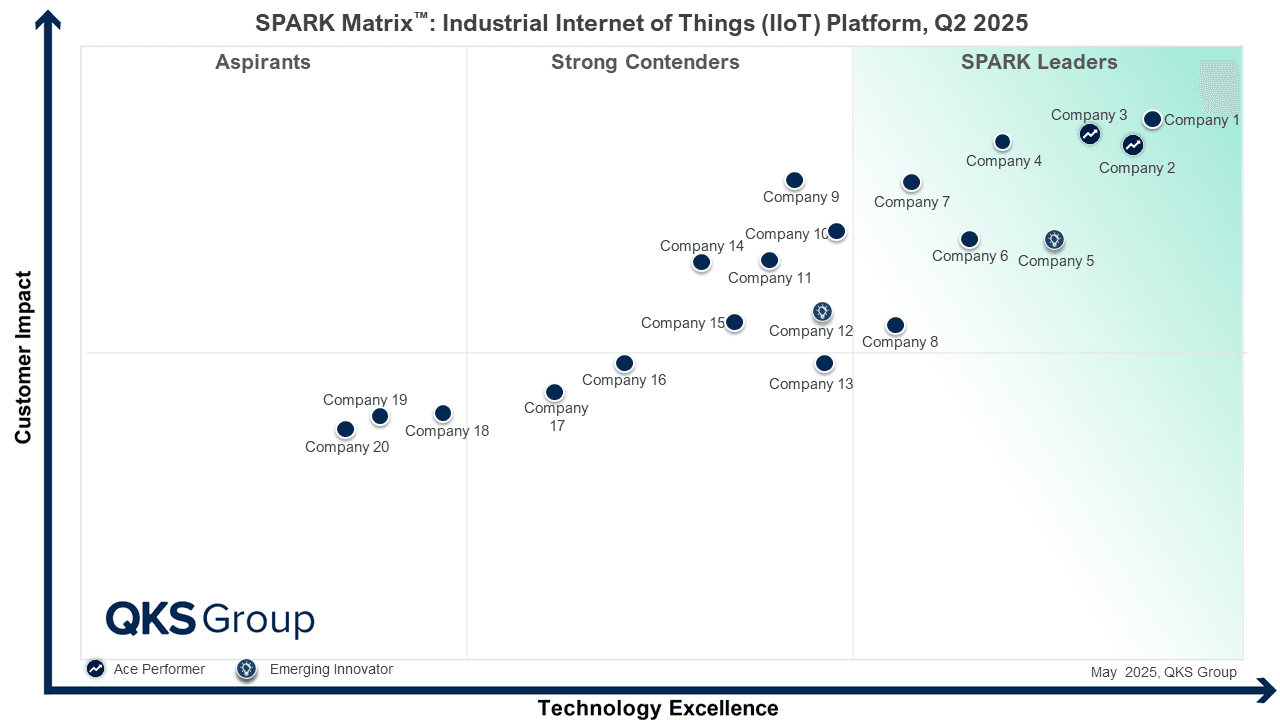
Analyst-driven evaluations such as the SPARK Matrix™ from QKS Group provide structured, comparative insights into vendor capabilities and market positioning.
Future Outlook (2025–2028)
Between 2025 and 2028, the Industrial IoT platform market will evolve into a foundational layer for autonomous industrial enterprises. Key expectations include:
- Widespread adoption of UNS-based architectures
- Deeper convergence of IIoT, AI, and digital twins
- Greater emphasis on outcome-driven, autonomous operations
- Increased regulatory focus on security and sustainability
Market leadership will favor vendors that deliver holistic, AI-native ecosystems—platforms designed not just to analyze operations, but to optimize and orchestrate them in real time.
Download Sample Report Here:https://qksgroup.com/download-sample-form/spark-matrix-industrial-internet-of-things-iiot-platform-q2-2025-8736
Conclusion
The Industrial IoT platform market is no longer about connectivity alone. It is about building intelligent, resilient, and sustainable industrial ecosystems. As UNS breaks down IT–OT barriers and open architectures replace proprietary constraints, enterprises gain unprecedented control over their operations.
Organizations that invest early in flexible, AI-native IIoT platforms will be best positioned to lead in the next era of industrial transformation.

 English
 Kiswahili
 Arabic
 French
 Spanish
 Portuguese
 Deutsch
 Turkish
 Dutch
Dutch
 Russian
 Romaian
 Portuguese (Brazil)
 Greek
Greek
