


SPARK Matrix™ 2025: Strategic Insights into IT Infrastructure Monitoring Tools
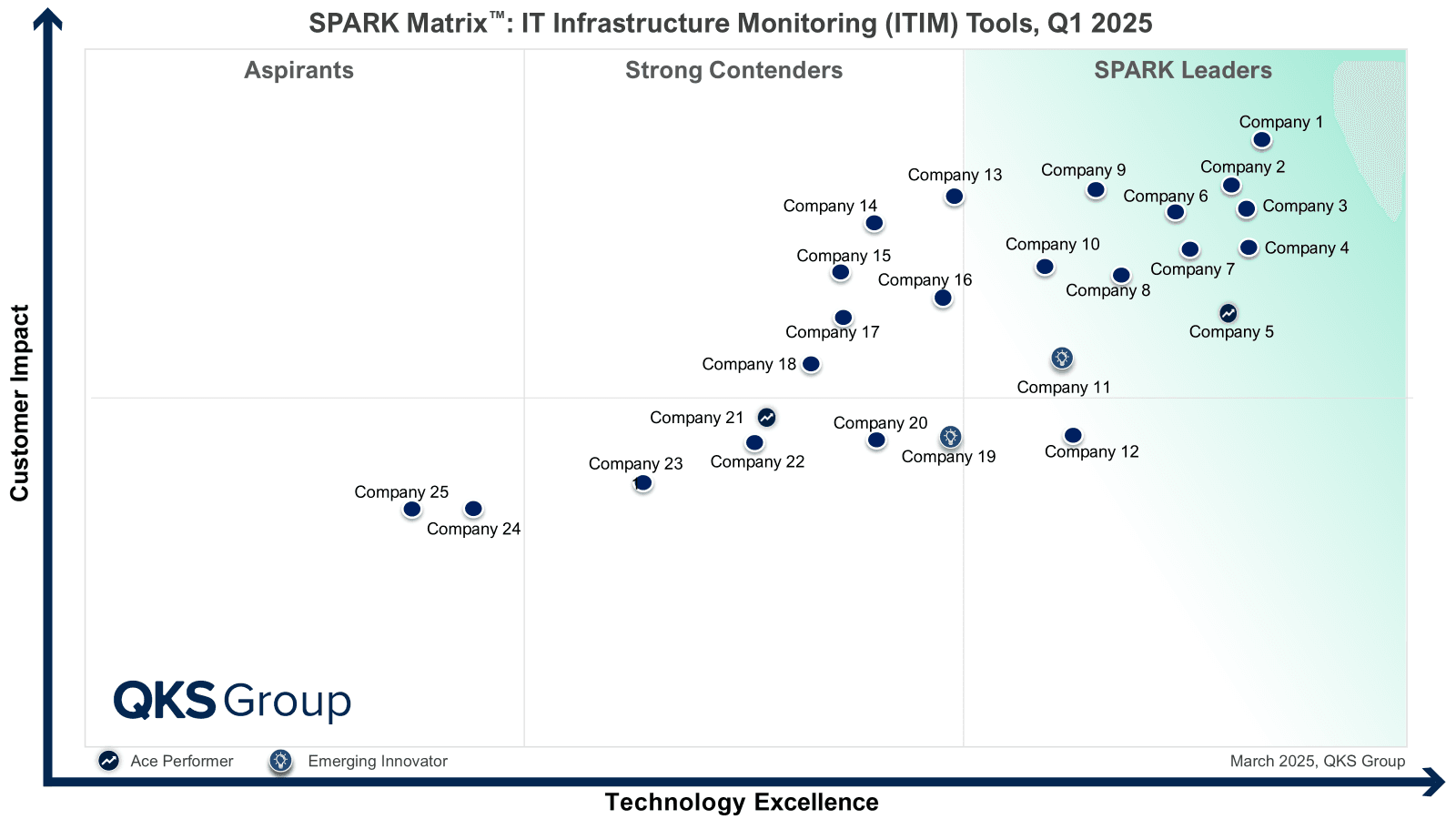
Introduction – Why IT Infrastructure Monitoring Matters Today
Modern enterprises operate in an always-on digital environment. Applications are distributed across data centers, clouds, and edge locations. Downtime, latency, or blind spots in infrastructure can directly impact revenue, customer experience, and brand trust. IT Infrastructure Monitoring (ITIM) Tools have therefore become a strategic necessity rather than an operational afterthought.
As IT environments grow more complex and hybrid by design, organizations need real-time, unified visibility into infrastructure health, performance, and availability. ITIM tools provide this foundation by continuously collecting telemetry across the entire IT stack and translating raw metrics into actionable intelligence for IT and business leaders.
Click Here For More Information: https://qksgroup.com/market-research/spark-matrix-it-infrastructure-monitoring-itim-tools-q1-2025-8552
Market / Industry Overview – Understanding the ITIM Domain
IT Infrastructure Monitoring (ITIM) Tools are software platforms designed to monitor compute, storage, network, virtualization, cloud, containers, databases, and supporting services. They collect metrics, logs, events, and traces from across on-premises, cloud, and hybrid environments.
From a business perspective, ITIM tools sit at the core of operational resilience. They enable IT teams to proactively detect anomalies, prevent outages, and maintain service-level objectives (SLOs). As enterprises adopt multi-cloud, microservices, and DevOps operating models, ITIM solutions are evolving into intelligent, analytics-driven platforms that support both infrastructure and application-centric monitoring strategies.
Key Challenges Businesses Face
Despite growing adoption, organizations continue to face several monitoring-related challenges:
- Tool sprawl and silos – Multiple point tools create fragmented visibility and higher operational overhead.
- Hybrid and multi-cloud complexity – Monitoring consistency across on-prem, private cloud, and public cloud remains difficult.
- Alert fatigue – Excessive, low-quality alerts reduce response effectiveness.
- Limited root cause analysis – Correlating metrics, logs, and traces manually slows down incident resolution.
- Scalability constraints – Traditional tools struggle with dynamic, containerized, and ephemeral workloads.
These challenges highlight why IT Infrastructure Monitoring (ITIM) Tools must evolve beyond basic uptime tracking.
Connecte With Our Analyst: https://qksgroup.com/analyst-briefing?analystId=13&reportId=8552
Key Trends & Innovations Shaping ITIM
The ITIM market is undergoing rapid transformation, driven by innovation across AI, cloud, and automation:
- AI/ML-driven monitoring – Predictive analytics, anomaly detection, and noise reduction improve accuracy and speed.
- Telemetry-first architectures – Unified ingestion of metrics, logs, traces, and events for full-stack visibility.
- Cloud-native monitoring – Support for Kubernetes, containers, and serverless environments.
- Automation and self-healing – Automated remediation workflows triggered by detected issues.
- Observability convergence – ITIM increasingly overlaps with application performance monitoring (APM) and observability platforms.
These advancements position modern ITIM platforms as decision-support systems rather than passive monitoring tools.
Benefits & Business Impact
When deployed effectively, ITIM delivers measurable business value:
- Reduced downtime through proactive detection and faster root cause analysis
- Improved operational efficiency by minimizing manual troubleshooting
- Higher infrastructure utilization through performance and capacity insights
- Enhanced security posture via early detection of abnormal behavior
- Scalability and agility to support digital transformation initiatives
From an ROI perspective, IT Infrastructure Monitoring (ITIM) Tools help enterprises move from reactive firefighting to predictive, data-driven operations.
Use Cases and Real-World Examples
ITIM tools support a wide range of enterprise use cases, including:
- Hybrid cloud operations – Unified visibility across private data centers and public cloud workloads.
- Critical application monitoring – Ensuring performance and availability of ERP, CRM, and customer-facing systems.
- DevOps and SRE enablement – Supporting CI/CD pipelines with real-time infrastructure feedback.
- Capacity planning – Forecasting infrastructure needs based on historical and real-time data.
- Business continuity – Detecting early warning signs to prevent service outages during peak demand.
For example, a global enterprise using ITIM analytics can identify storage bottlenecks weeks in advance and avoid costly service disruptions.
How Organizations Can Choose the Right Solution
Selecting the right ITIM platform requires a strategic approach:
- Coverage across the full infrastructure stack
- Support for hybrid, multi-cloud, and containerized environments
- Advanced analytics and AI capabilities
- Low operational overhead and ease of integration
- Scalable architecture aligned with future growth
Decision-makers should prioritize solutions that align monitoring insights with business outcomes, not just technical metrics.
Future Outlook (2025–2028)
Between 2025 and 2028, ITIM tools will continue to evolve into autonomous, intelligence-driven platforms. Expect deeper integration with observability, security monitoring, and IT service management. AI-powered forecasting and automated remediation will become mainstream, enabling near-zero-touch operations.
As digital infrastructure becomes the backbone of enterprise competitiveness, ITIM will be central to resilience, compliance, and innovation strategies.
Download Sample Report Here: https://qksgroup.com/download-sample-form/spark-matrix-it-infrastructure-monitoring-itim-tools-q1-2025-8552
Conclusion – Reinforcing the Value of ITIM
In an era of complex, distributed IT environments, visibility equals control. IT Infrastructure Monitoring (ITIM) Tools empower organizations to maintain performance, availability, and trust across their digital ecosystems. By combining real-time telemetry, analytics, and automation, modern ITIM platforms transform infrastructure monitoring into a strategic enabler of business continuity and growth.

 English
 Arabic
 French
 Spanish
 Portuguese
 Deutsch
 Turkish
 Dutch
Dutch
 Italiano
 Russian
 Romaian
 Portuguese (Brazil)
 Greek
Greek
