


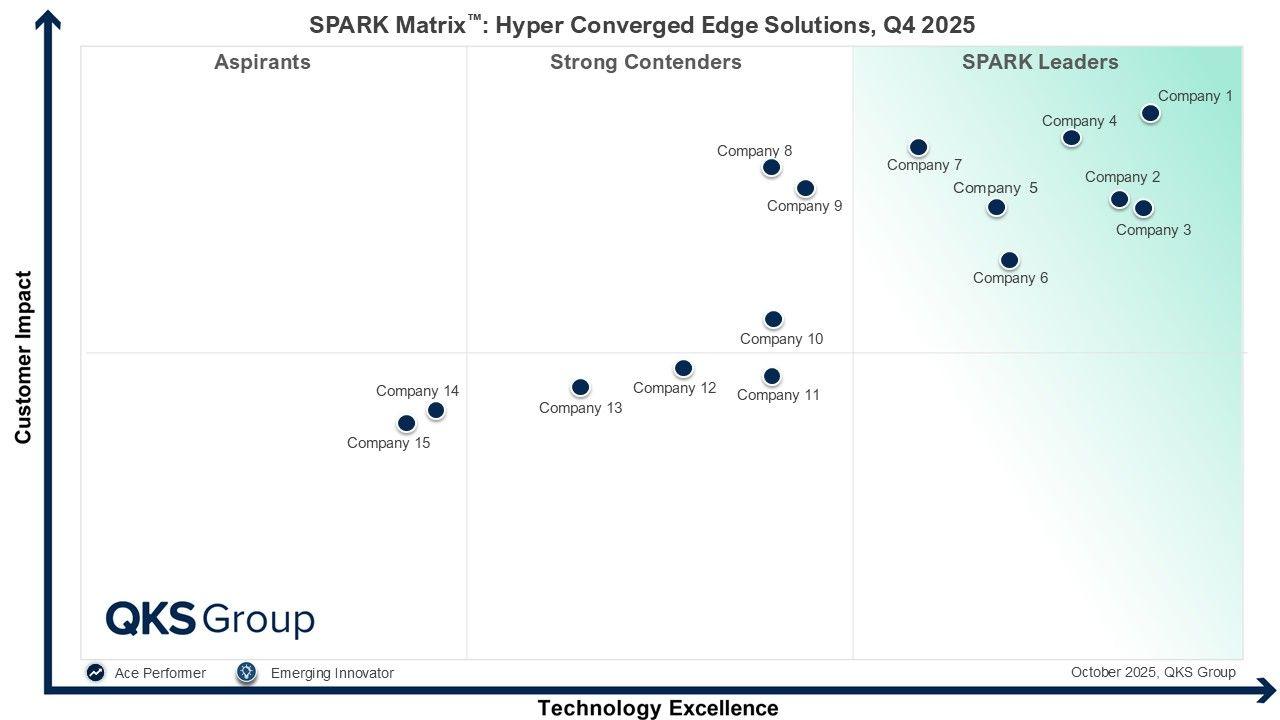
SPARK Matrix™: Hyper Converged Edge Solutions Market Leaders and Strategic Insights
Introduction – Why Hyperconverged Edge Matters Today
As enterprises push applications, data, and intelligence closer to where business happens, the edge has become a critical battleground for IT strategy. Retail stores, manufacturing plants, branch offices, remote facilities, and industrial sites all demand real-time processing, high availability, and minimal operational complexity. This is where Hyperconverged Edge Solutions are gaining strategic importance.
Unlike centralized data centers, edge environments often lack skilled IT staff, space, and consistent connectivity. Organizations need infrastructure that is compact, resilient, and easy to manage—without compromising performance or security. Hyperconverged edge solutions address this need by delivering simplified, software-defined infrastructure purpose-built for distributed and remote locations.
Market / Industry Overview – Understanding Hyperconverged Edge Solutions
Hyperconverged Edge Solutions represent an evolution of traditional hyperconverged infrastructure (HCI), adapted specifically for edge and remote use cases. While data center HCI focuses on large-scale consolidation and elastic scalability, edge HCI prioritizes simplicity, operational resilience, and lightweight deployment models.
At its core, a hyperconverged edge solution integrates:
- Compute, storage, and networking in a single, software-defined appliance
- Centralized management and orchestration
- High availability in two-node or small cluster configurations
- Support for constrained environments with limited power, space, and IT expertise
Industries such as retail, manufacturing, energy, transportation, healthcare, and telecommunications are adopting edge HCI to support latency-sensitive applications, local data processing, and business continuity. Market evaluations and competitive benchmarks from firms like QKS Group highlight that edge-specific design, not data center scale, is now the key differentiator.
Key Challenges Businesses Face
As edge deployments expand, enterprises encounter several persistent challenges:
- Operational complexity: Managing hundreds or thousands of distributed sites strains traditional IT models.
- Limited IT resources: Many edge locations operate without on-site technical staff.
- High availability requirements: Downtime at the edge directly impacts revenue and customer experience.
- Latency sensitivity: Centralized cloud or data center processing may not meet real-time application needs.
- Security risks: Distributed infrastructure increases the attack surface if not centrally governed.
These challenges make conventional infrastructure approaches impractical for edge environments.
Key Trends & Innovations Shaping the Market
The rapid evolution of Hyperconverged Edge Solutions is being driven by several technology and business trends:
- Edge-native virtualization: Lightweight hypervisors optimized for small clusters and constrained hardware.
- Cloud-integrated management: Centralized control planes that manage edge, core, and cloud from a single console.
- AI and analytics at the edge: Local inference for video analytics, predictive maintenance, and IoT workloads.
- Automation-first operations: Zero-touch provisioning, automated updates, and policy-based management.
- Built-in resilience: Two-node clusters with automated failover and data protection for remote sites.
These innovations are shifting edge infrastructure from fragile, standalone systems to enterprise-grade platforms.
Benefits & Business Impact
When deployed strategically, Hyperconverged Edge Solutions deliver measurable business value across IT and operations:
- Lower total cost of ownership (TCO): Reduced hardware footprint and simplified management lower CapEx and OpEx.
- Improved uptime: Built-in redundancy and automated recovery enhance service continuity.
- Operational efficiency: Centralized management reduces the need for local IT intervention.
- Scalability at the edge: Standardized appliances make it easy to replicate deployments across sites.
- Stronger security posture: Consistent policies, encryption, and access controls across all locations.
For CXOs and IT leaders, the ROI is driven not just by cost savings, but by improved agility and risk reduction.
Use Cases and Real-World Applications
Hyperconverged edge platforms are enabling a wide range of real-world scenarios:
- Retail: In-store analytics, POS systems, and inventory management with local resilience.
- Manufacturing: Edge computing for shop-floor control systems and real-time quality inspection.
- Energy & Utilities: Remote monitoring and control of substations, pipelines, and renewable assets.
- Healthcare: Edge infrastructure for clinics and diagnostic centers with limited IT staff.
- Transportation & Logistics: Local data processing for hubs, depots, and smart traffic systems.
These use cases demonstrate how Hyperconverged Edge Solutions support mission-critical workloads beyond the data center.
How Organizations Can Choose the Right Solution
Selecting the right hyperconverged edge platform requires a clear, outcome-driven approach:
- Edge readiness: Evaluate support for two-node clusters, low-resource environments, and rugged deployments.
- Management simplicity: Look for centralized, cloud-based lifecycle management.
- Integration: Ensure compatibility with existing virtualization, backup, and security tools.
- Resilience features: Assess high availability, data protection, and disaster recovery capabilities.
- Vendor roadmap: Prioritize solutions aligned with edge, AI, and hybrid cloud strategies.
A structured evaluation helps avoid over-engineered platforms designed primarily for data centers.
Future Outlook (2025–2028)
Between 2025 and 2028, hyperconverged edge infrastructure is expected to become a foundational layer for distributed digital operations. As enterprises deploy more AI-driven, latency-sensitive applications, edge HCI will evolve to support autonomous operations, deeper cloud integration, and tighter security automation.
The convergence of edge computing, AI, and hybrid cloud will further accelerate adoption, positioning hyperconverged edge solutions as a strategic pillar of modern IT architecture.
Conclusion – Reinforcing the Strategic Value
Hyperconverged Edge Solutions are redefining how enterprises design and manage infrastructure outside the data center. By combining simplicity, resilience, and centralized control, they empower organizations to scale edge operations with confidence. For technology buyers and decision-makers, edge-focused hyperconvergence is no longer a tactical choice—it is a strategic enabler of digital transformation.

 English
 Kiswahili
 Arabic
 Spanish
 Portuguese
 Deutsch
 Turkish
 Dutch
Dutch
 Italiano
 Russian
 Romaian
 Portuguese (Brazil)
 Greek
Greek
