


How Cylinder Materials Affect Engine Durability
Introduction to Cylinder Wear Resistance
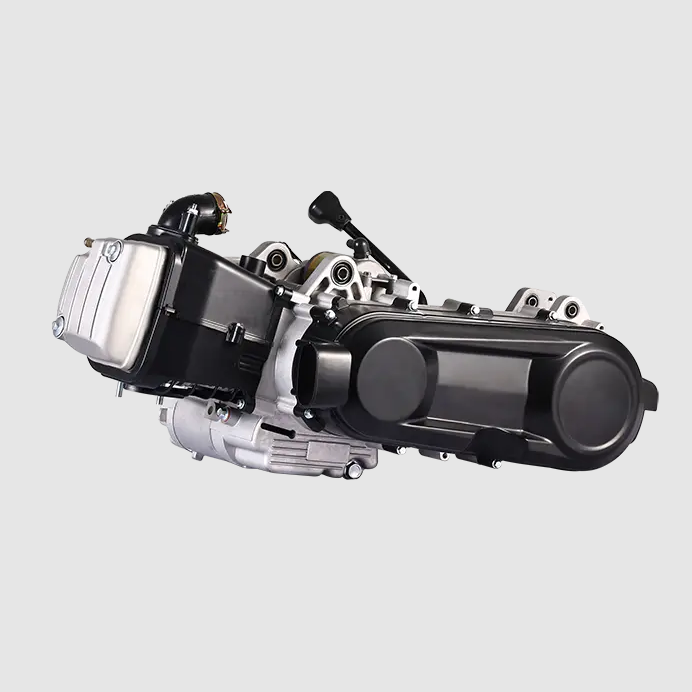
Cylinder material selection is a critical factor influencing engine longevity, performance stability, and maintenance frequency. In modern production environments such as a Scooter Engine Factory, choosing appropriate cylinder materials ensures that engines can withstand continuous friction, fluctuating temperatures, and varying lubrication conditions. Because the cylinder is in constant contact with the piston and rings, its wear resistance directly impacts compression stability, oil consumption, and overall efficiency. This makes the study of cylinder materials essential for guaranteeing reliable scooter operation across all riding environments.
Common Materials and Their Base Characteristics
Traditional scooter cylinders are often made from cast iron due to its excellent machinability, good thermal stability, and reliable wear resistance. Cast iron contains graphite flakes, which contribute natural lubricating properties, helping reduce surface abrasion. However, weight and heat dissipation limitations lead many manufacturers to adopt aluminum alloy cylinders combined with surface treatments. Aluminum alloys are significantly lighter and offer faster heat dissipation, which benefits engine cooling and reduces the risk of temperature-induced wear. Although aluminum itself is softer and less wear-resistant than iron, advanced surface coatings compensate for this drawback and allow these cylinders to achieve long service lives.
Advances in Plating and Coating Technologies
Modern engineering emphasizes surface treatments that greatly enhance wear performance. Nickel–silicon carbide plating, widely known as Ni-SiC or Nikasil, is one of the most prevalent solutions. This coating embeds hard silicon carbide particles into a nickel matrix, creating an extremely durable and low-friction surface. A cylinder treated with this process exhibits superior resistance to scoring, ring abrasion, and thermal expansion stress. In a Scooter Engine Factory, adopting such coating technologies not only improves durability but also enhances power output by enabling tighter manufacturing tolerances and more efficient heat transfer. Other surface technologies, such as chrome plating or ceramic composite coatings, offer similarly impressive wear-resistance benefits in high-performance engines.
Influence of Lubrication on Wear Performance
Even the strongest cylinder materials rely on consistent lubrication to maintain wear resistance. Oil forms a protective film between the piston rings and cylinder wall, reducing direct metal-to-metal contact. If lubrication breaks down due to poor oil quality, contamination, or insufficient engine maintenance, cylinder wear accelerates dramatically regardless of the material used. For this reason, many manufacturers design surface coatings that retain oil more effectively, improving boundary lubrication during high-temperature or high-load operation. This combination of robust material and optimized lubrication behavior significantly reduces long-term wear.
Impact of Thermal Behavior and Cooling Efficiency
Wear resistance is also strongly influenced by heat management. Aluminum alloy cylinders coated with advanced materials dissipate heat faster than cast iron, leading to more stable operating temperatures. When a cylinder runs cooler, the risk of thermal expansion mismatch and localized hot spots decreases. This helps maintain surface integrity and consistent clearances between the piston and cylinder wall. In contrast, cast iron cylinders, though durable, may retain heat longer, potentially contributing to increased wear if ventilation or cooling systems are insufficient. A carefully engineered balance between material properties and cooling performance is therefore essential in modern scooter engine design.
Manufacturing Precision and Quality Control
The level of machining accuracy in a Scooter Engine Factory directly affects how well a cylinder will resist long-term wear. Honing patterns, coating thickness uniformity, and surface smoothness all play significant roles in determining how piston rings interact with the cylinder wall. Fine cross-hatch patterns help retain lubricating oil, while overly rough or uneven surfaces increase friction. Modern factories adopt CNC machining, automated coating systems, and rigorous inspections to ensure cylinders meet tight tolerances and uniform surface specifications, ultimately improving durability.
Nominal displacement:50ml
Displacement:49.4ml
Bore:39mm
Stroke:41.4mm
Compression ratio:10.5:1
Maximum power:2.7kw/7000r/min
Maximum torque:3.2N·m/5500r/min
Maximin fuel comsumption:≤367g/kW·h
Minimum stable idle speed:1700±100r/min

 English
 Kiswahili
 Arabic
 Spanish
 Portuguese
 Deutsch
 Turkish
 Dutch
Dutch
 Italiano
 Russian
 Romaian
 Portuguese (Brazil)
 Greek
Greek
