


Europe Heat Exchanger Industry Analysis: Market Size, Technology Trends, and Key Opportunities
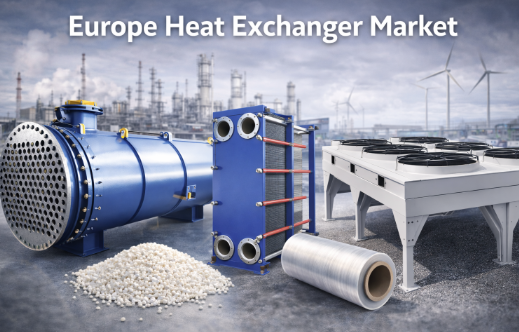
The Europe heat exchanger market is projected to reach USD 9.56 billion by 2030 from USD 6.95 billion in 2025, at a CAGR of 6.6% during the forecast period. The market is driven by industrial growth, strict environmental regulations, and energy-efficient technologies. The market is sustained by strong demand from industries such as chemicals, power generation, HVAC, food & beverages, automotive, and oil & gas that constantly require advanced heating during operations. The European Union has set stringent standards for carbon emissions and energy efficiency, compelling the industrial sector to adopt high-performance heat exchangers. Trends such as renewable energy systems, district heating, waste heat recovery, and the electrification of vehicles support this market's growth. Innovations such as compact and modular designs, the use of corrosion-resistant materials, and clever monitoring systems contributed to reliability and efficiency, thereby driving market acceptance. Besides, government policies that advocate environmentally sound manufacturing, the clean energy transition, and industry upgrading, paired with infrastructure investment and the modernization of old plants, have been beneficial for the growth of the European heat exchanger market.
Download PDF Brochure: https://www.marketsandmarkets.com/pdfdownloadNew.asp?id=72559192
Metals are the fastest-growing material in the European heat exchanger market, due to their superior thermal conductivity, mechanical strength, and durability, which perform well and are energy-efficient. The commonly used metals in the processes are stainless steel, aluminum, copper, titanium, and nickel alloys because they are able to endure high temperatures, pressures, and aggressive conditions (corrosive) that are typical in the chemical, oil & gas, power generation, and HVAC industries. The rising trend of waste heat recovery, renewable energy, hydrogen production, and district heating systems in Europe requires materials that are very strong, have long lifespans and almost no maintenance, and favor metal-based heat exchangers. Besides, metals enable compact and light designs, with aluminum being favored in automotive and HVAC applications due to its energy-saving and space-saving properties. To comply with the stringent European safety and quality requirements, the use of certified and reliable metallic materials is preferred over other materials, which is one of the reasons their acceptance in the industrial and commercial applications is increasing rapidly.
Shell & tube heat exchangers hold the largest share in the Europe heat exchanger market because of their diverse applications, strong construction, and capability to work under high pressure and high-temperature conditions. Moreover, they are still the most popular choice of heavy industries such as oil & gas, chemical, power generation, refineries, and petrochemical, which are very much present in Europe. Besides, their simple structure, easy cleaning, and large fluid-volume handling flexibility make them the right choice for the most demanding and continuous processes in the industry. A wide range of materials, including corrosion-resistant metals, can be used for shell and tube heat exchangers, which allows their application even in aggressive and hazardous environments. Additionally, the long operational life, reliability, and customized solutions have made these heat exchangers very popular in the industry.
The chemical industry dominates the Europe heat exchanger market because of the high demand for good thermal management in ranging processes like heating, cooling, condensation, evaporation, and heat recovery. Continuous chemical production involves operations that are carried out under high temperatures, high pressure, and in corrosive environments, which all lead to the strong demand for reliable and durable heat exchangers. Europe has an established and well-functioning chemical industry with big production plants, refineries, and specialty chemical plants in various countries such as Germany, France, and the Netherlands, where the sector is particularly strong. Additionally, the industry is being pressed to adopt the latest heat exchanger technologies through stringent safety, energy efficiency, and environmental regulations, as they help not only to cut down on energy consumption and emissions but also to avoid being penalized or receiving negative publicity. Moreover, the constant focus on process optimization, waste heat recovery, and the use of sustainable and low-carbon chemical production techniques leads to demand that does not fluctuate much. Plant upgrades, maintenance, and capacity expansions are some of the contributing factors that make the replacement and retrofit demand steady thus, the chemical industry continues to hold the largest share of the Europe heat exchanger market.
Get a Sample Copy of This Report: https://www.marketsandmarkets.com/requestsampleNew.asp?id=72559192
The heat exchanger market in Europe is mainly supported by the region's key activities such as energy efficiency, decarbonization, and sustainable industrial development. The demand for advanced heat exchangers is also accelerating due to investments in various areas such as renewable energy, hydrogen infrastructure, district heating, data centers, and waste heat recovery systems. Retrofitting and upgrading outdated industrial and commercial buildings to comply with strict environmental laws could bring about considerable growth in the market. The market is being sustained by technical innovation and the coming up of smaller, lighter designs, corrosion-resistant alloys which can withstand more, and the use of additive manufacturing to produce complicated geometries. The installation of smart technologies like IoT sensors, digital twins, and predictive maintenance systems is making the operation more efficient, reliable, and longer-lasting which in turn is helping the technology to be more widely used throughout Europe.
Europe Heat Exchanger Companies
Major players operating in the Europe heat exchanger market include ALFA LAVAL (Sweden), Kelvion Holding GmbH (Germany), Danfoss (Denmark), Exchanger Industries Limited (Canada), Mersen (France), API Heat Transfer (US), Johnson Controls (Ireland), Xylem (US), Wabtec Corporation (US), SPX FLOW (US), LU-VE S.p.A. (Italy), Modine Manufacturing Company (US), and Wieland (Germany), among others. These companies have dependable manufacturing facilities in the Europe. They have a well-established portfolio that includes reliable goods and services, a strong market presence, and effective business plans. These businesses also possess a sizable portion of the market, a broader range of products, products with more end-users, and use cases that span more geographic regions.
ALFA LAVAL (Sweden) is an international pioneer in heat transfer, separation, and fluid-handling equipment. Its main products are separators, heat exchangers, pumps, and valves. The company operates in three business segments: marine, energy, and food and water. The energy division is where ALFA LAVAL's heat exchangers come from. The company offers a complete line of heat exchanger products, as well as Aalborg, Cetetube, ViscoLine, Pharma-line, AlfaCond, AlfaQ, AlfaVap, and BaseLine. Additionally, it works on getting customized products for particular applications and operating conditions. The firm sells its products and solutions in a variety of industries, such as chemicals, energy, biotech & pharmaceuticals, food & beverages, marine, transportation, mining, minerals & pigments, machinery & manufacturing, semiconductors & electronics, metallurgy, automotive, and pulp & paper. Heat exchangers from ALFA LAVAL are made to transfer heat with maximum efficiency; they use different technologies such as shell & tube, plate & frame, and brazed plate. Moreover, installation, maintenance, and repair are among the services the company provides to support its heat exchangers. ALFA LAVAL is represented in North America, South America, the Middle East & Africa, Asia Pacific, and Europe. It has a presence in about 100 countries with sales organizations in 50 of them. The company has 42 large production sites, of which 22 are in Europe. In Europe, the company has offices in Albania, Armenia, Austria, Azerbaijan, Belgium, Bosnia and Herzegovina, Bulgaria, Croatia, Cyprus, Czech Republic, Denmark, Estonia, Finland, France, Georgia, Germany, Greece, Hungary, Iceland, Ireland, Italy, Kosovo, Latvia, Lithuania, Luxembourg, Malta, Moldova, Montenegro, Netherlands, North Macedonia, Norway, Poland, Portugal, Spain, Sweden, Turkey, UK, Ukraine, Switzerland, Slovenia, and Slovika.
Inquire Before Buying: https://www.marketsandmarkets.com/Enquiry_Before_BuyingNew.asp?id=72559192
Kelvion Holding GmbH (Germany) is one of the leading players in the global heat exchangers, both as a manufacturer and distributor. The company was initially part of the heat exchanger division of GEA Group AG. The GEA heat exchangers division was sold to the Triton Fund (London) in 2014. In 2015, the ex-division was named Kelvion to focus on the heat exchangers market. Kelvion's product portfolio comprises a variety of heat exchangers, including plate, shell & tube, air-cooled models, and specially designed ones for diesel engine exhaust gas recirculation (EGR) systems. It also produces heat exchangers for diverse sectors like oil & gas, power generation, HVAC, chemicals, commercial buildings, climate & environment, shipping, and food & beverages. Besides, it provides post-sales support, including upgrades, modifications, and maintenance, as well as supplying spare parts. In the European continent, the company operates through its offices in Germany, Sweden, Belgium, the UK, the Netherlands, Poland, the Czech Republic, Italy, Denmark, France, Spain, Estonia, and Austria.

 Kiswahili
 Arabic
 French
 Spanish
 Portuguese
 Deutsch
 Turkish
 Dutch
Dutch
 Italiano
 Russian
 Romaian
 Portuguese (Brazil)
 Greek
Greek
